


Post Contents
DPD driver earnings in the UK vary considerably depending on the type of driving arrangement.
Current figures show that delivery drivers are reported at around £13.95 per hour, while DPD advertises up to £18 per hour for Connect drivers and £50,000 to £60,000 in revenue per route for self-employed Owner Drivers.
The important point is that these figures do not all represent the same thing. Some are employee salaries, some are third-party salary estimates and others represent self-employed business revenue before costs and tax.
Last updated: 18 August 2026
How Much Do DPD Drivers Earn in the UK in 2026?
There is no single DPD driver salary because the company uses several driving arrangements. Current DPD recruitment information and recent salary estimates provide the following picture.
| DPD Driver Type | Current Pay Indicator | Employment Arrangement |
| DPD Connect Driver | Up to £18 per hour | Self-employed |
| Employed DPD Driver | From £24,000 advertised | Employee |
| Owner Driver Worker | From £27,000 advertised | Self-employed arrangement |
| Owner Driver | £50,000–£60,000 revenue per route | Self-employed |
| Delivery Driver | Around £13.95 per hour | Third-party reported average |
| 7.5 Tonne Driver | Around £16.13 per hour | Third-party reported average |
| Truck Driver | Around £16.69 per hour | Third-party reported average |
| Owner Operator Driver | Around £54,529 per year | Third-party reported average |
Recent DPD salary estimates on Indeed are based on thousands of past and present job postings across DPD roles. Indeed’s July 2026 data reports approximately £13.95 per hour for delivery drivers, £16.13 for 7.5-tonne drivers and £16.69 for truck drivers.
These should still be treated as estimates rather than guaranteed rates. Actual earnings can depend on the depot, contract, route, working hours, experience and whether the driver is employed or operating as a self-employed courier.
What Are the Different Types of DPD Driver Jobs?
Understanding the employment arrangement is essential before comparing DPD driver earnings. Two drivers delivering identical DPD parcels could have significantly different pay structures and expenses.
Employed DPD Drivers
DPD’s recruitment information currently advertises employed driver earnings from £24,000 and states that these drivers are DPD employees. The listed package includes a provided vehicle, sick pay, holiday pay and pension arrangements.
However, applicants should confirm the current hourly rate and contracted hours when applying. The UK National Living Wage increased to £12.71 per hour for eligible workers aged 21 and over from 1 April 2026, so an advertised annual headline should always be considered alongside the actual hours required.
Anyone applying for an employed position may also want to prepare for a job interview before attending a depot-based assessment or recruitment meeting.
DPD Connect Drivers
DPD Connect provides a more flexible local delivery arrangement. DPD currently states that Connect drivers can earn up to £18 per hour, are paid weekly and use their own vehicle. Parcels are collected from a local collection point and deliveries are generally made within the driver’s local area.
The headline rate is attractive compared with many traditional courier roles, but Connect drivers need to consider their own motoring expenses. Fuel, insurance, servicing and vehicle depreciation can reduce the amount that remains as personal income.
DPD Owner Driver Workers
DPD currently advertises its Owner Driver Worker option as earning from £27,000. Its recruitment information also lists sick pay, paid holiday and a pension alongside a self-employed arrangement and options involving leased or personally owned vans.
Because the structure differs from a conventional employee position, anyone considering this option should read the current agreement carefully and establish exactly which vehicle costs, tax responsibilities and benefits apply.
DPD Owner Drivers
The highest headline earnings are associated with the Owner Driver model.
DPD’s current driver recruitment information advertises £50,000 to £60,000 in revenue per route for Owner Drivers. It also makes clear that Owner Drivers are self-employed and responsible for their own tax and insurance contributions. Lease and own-van options are available.
That £50,000 to £60,000 figure should therefore not be interpreted automatically as an employee salary or the amount a driver personally keeps.
How Much Do Employed DPD Drivers Earn?
DPD’s recruitment page currently shows employed driver earnings beginning from £24,000. It also lists a company-provided vehicle, sick pay, holiday pay and pension benefits for this employment model.
Actual annual earnings may be higher depending on the position, hours, location and additional payments.
For comparison, Indeed’s broader “Driver” category currently reports an average of £35,942 per year, although this figure is based on a relatively small salary sample and should not be treated as DPD’s official salary scale.
Someone offered £24,000 should also check how many paid hours the contract covers. Current UK minimum wage rates require eligible workers aged 21 and over to receive at least £12.71 per hour from April 2026.
How Much Do DPD Delivery Drivers Earn Per Hour?
Indeed’s DPD salary data, updated in July 2026, puts average UK delivery-driver pay at approximately £13.95 per hour, based on 79 reported salaries or job postings. The displayed range runs considerably wider, which reinforces that £13.95 is an estimate rather than a fixed national DPD rate.
For an illustration, a driver receiving £13.95 for 40 paid hours each week would gross approximately:
- £111.60 for an eight-hour paid day
- £558 for a 40-hour paid week
- £2,418 per month on an annualised basis
- £29,016 per year if the same hours and rate continued for 52 weeks
These are mathematical illustrations rather than guaranteed DPD earnings. Overtime, unpaid breaks, holidays, working patterns and employment status can change the result.
How Much Do DPD 7.5 Tonne Drivers Earn?
Indeed currently reports average DPD 7.5-tonne driver pay at around £16.13 per hour, based on 94 reported salaries.
At 40 paid hours each week, that hourly rate would be equivalent to approximately £645.20 per week or £33,550 per year before tax if maintained consistently throughout the year.
A 7.5-tonne role can involve different licensing, vehicle and operational responsibilities from ordinary parcel-van delivery, so candidates should compare the requirements of the specific vacancy rather than relying solely on the average rate.
How Much Do DPD Truck and HGV Drivers Earn?

Current Indeed data places DPD truck-driver earnings at approximately £16.69 per hour, based on 257 reported salaries.
At 40 paid hours per week, that would be roughly £667.60 per week or £34,715 annually before tax if the rate and hours remained unchanged.
Truck and HGV earnings can vary according to licence category, shift pattern, nights, depot, experience and the type of work being undertaken.
How Much Do DPD Owner Drivers Earn?
DPD currently promotes Owner Driver revenue of £50,000 to £60,000 per route. This is one of the main reasons searches about DPD driver earnings often mention salaries of £50,000 or more.
Indeed’s separate Owner Operator Driver data currently reports an average of about £54,529 per year, based on 261 reported salaries or job postings.
However, self-employed revenue should never be compared directly with employee salary without considering costs.
An Owner Driver may have to account for:
- Van leasing, financing or depreciation
- Fuel or electric charging
- Courier and commercial vehicle insurance
- Servicing and MOT costs
- Tyres and repairs
- Breakdown costs
- Mobile phone and data
- Accounting or bookkeeping
- Tax
- National Insurance where applicable
- Time away from work
- Other business expenses
For anyone considering running deliveries independently, the practical requirements involved in starting a courier business can help put these responsibilities into context.
Can DPD Drivers Really Earn £60,000 a Year?
Yes, £60,000 appears in DPD’s current Owner Driver advertising, but the wording matters. DPD describes the opportunity as earning £50,000 to £60,000 in revenue per route rather than promising a £60,000 employee salary.
A simplified Owner Driver calculation looks more like this:
- Gross route revenue
- minus van costs
- minus fuel
- minus insurance
- minus servicing and repairs
- minus other allowable business costs
- equals business profit before personal tax
Therefore, a route producing £60,000 of revenue does not mean that £60,000 reaches the driver’s personal bank account as disposable income.
Drivers moving into this model also need to understand their tax position and may need to register as self-employed depending on their circumstances.
How Much Do DPD Drivers Earn Per Day?
Daily DPD earnings depend heavily on the arrangement.
Using current reported or advertised rates purely as illustrations:
| Driver Arrangement | Approximate Daily Indicator |
| Delivery Driver at £13.95/hour | £111.60 for 8 paid hours |
| DPD Connect at £18/hour | Up to £144 for 8 paid hours |
| Indeed general Driver estimate | Around £124 per day reported |
| Courier Driver | Around £116 per day reported |
| Van Driver | Around £113 per day reported |
Indeed’s daily figures are based on relatively small samples, while Connect’s £18 rate is advertised as up to rather than guaranteed earnings.
A driver’s actual day may also be longer than the number of paid or billable hours used in a simple calculation.
How Much Do DPD Drivers Earn Per Week?
At the reported £13.95 hourly delivery-driver average, 40 paid hours would produce approximately £558 gross per week.
At DPD Connect’s advertised maximum of £18 per hour, 40 paid hours would theoretically produce up to £720 gross, although Connect work is flexible and a driver should not assume that 40 hours at the maximum rate will always be available.
Owner Driver revenue cannot be converted reliably into a guaranteed weekly wage because business costs, route arrangements and working patterns differ.
How Much Do DPD Drivers Earn Per Month?
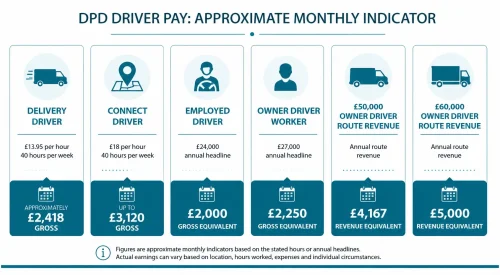
Using the same illustrations:
| Driver Type | Approximate Monthly Indicator |
| Delivery Driver at £13.95/hour and 40 hours/week | £2,418 gross |
| Connect Driver at £18/hour and 40 hours/week | Up to £3,120 gross |
| Employed Driver £24,000 annual headline | £2,000 gross equivalent |
| Owner Driver Worker £27,000 annual headline | £2,250 gross equivalent |
| £50,000 Owner Driver route revenue | £4,167 revenue equivalent |
| £60,000 Owner Driver route revenue | £5,000 revenue equivalent |
The final two figures are route revenue equivalents, not take-home pay. Owner Drivers still have business expenses and personal tax considerations.
What Expenses Do Self-Employed DPD Drivers Have?
The higher headline earning potential attached to self-employed delivery work comes with greater financial responsibility.
Common expenses can include:
- Vehicle lease or finance payments
- Petrol, diesel or electricity
- Business-use vehicle insurance
- Courier insurance where required
- Vehicle servicing
- MOT testing
- Replacement tyres
- Repairs
- Breakdown cover
- Mobile phone costs
- Accounting
- Business administration
- Tax payments
These expenses can materially affect the difference between gross revenue and actual take-home income.
That is why comparing a £50,000 Owner Driver revenue figure directly with a £30,000 employee salary can be misleading. The employee normally does not have to fund the same range of business costs from their gross pay.
Do DPD Drivers Pay for Their Own Van and Fuel?
It depends on which DPD driving model is being used.
DPD says its employed drivers receive a vehicle. Connect drivers use their own vehicle, while Owner Drivers can use lease or own-van options.
| Cost | Employed Driver | DPD Connect | Owner Driver |
| Vehicle | Provided by DPD | Own vehicle | Own or lease arrangement |
| Fuel | Check contract | Driver expense | Business expense |
| Insurance | Employer arrangement applies to vehicle | Driver must ensure suitable cover | Driver responsibility |
| Maintenance | Lower personal exposure | Driver’s vehicle costs | Driver/business costs |
| Tax | Usually PAYE | Self-employed responsibility | Self-employed responsibility |
Applicants should always check the written agreement because individual arrangements can change and not every DPD-related delivery role is necessarily contracted directly on identical terms.
What Is the Difference Between an Employed and Self-Employed DPD Driver?
The difference affects much more than the headline rate.
| Factor | Employed DPD Driver | Self-Employed Driver |
| Pay structure | Salary or employee pay | Revenue or flexible earnings |
| Vehicle | DPD states vehicle provided | Own or leased vehicle depending on arrangement |
| Tax | Usually PAYE | Driver generally manages own tax |
| Holiday pay | Listed by DPD | Depends on arrangement |
| Sick pay | Listed for employees | Depends on arrangement |
| Pension | Listed for employees | Depends on arrangement |
| Business costs | Lower | Potentially significant |
| Income predictability | Usually greater | Can vary |
DPD’s Owner Driver Worker option is slightly different because the company currently describes it as self-employed while also advertising sick pay, paid holiday and pension benefits.
Candidates should therefore check the exact contractual terms rather than assuming that every self-employed DPD arrangement works in the same way.
What Factors Affect How Much a DPD Driver Earns?
Several factors can cause one DPD driver to earn considerably more than another.
Employment Model
Owner Drivers, Connect drivers and employed drivers are paid under different structures.
Location
Current Indeed data demonstrates regional differences. For example, July 2026 figures put delivery-driver pay at around £14.08 per hour across England, while the estimate for London was around £13.08 based on the available sample.
Licence and Vehicle Type
Larger-vehicle drivers generally show higher reported hourly averages than standard delivery drivers.
Working Hours
Longer schedules and overtime can increase gross earnings, although drivers also need to consider fatigue and applicable working-time rules. Information on how many hours you can work in a day by law in the UK is relevant when assessing demanding delivery schedules.
Route and Workload
A productive route can affect self-employed earnings, but parcel volume should not automatically be treated as direct pay per parcel unless the driver’s contract specifically uses that method.
Vehicle Expenses
Fuel, maintenance and insurance can substantially change the net earnings of a self-employed driver.
How Does DPD Driver Pay Compare With Other Delivery Jobs?
DPD’s reported delivery-driver rate of around £13.95 per hour sits within the broader UK delivery market, but a meaningful comparison has to consider benefits, contracted hours, vehicle provision and whether a role is employed or self-employed.
For example, comparing DPD with Tesco delivery driver earnings can help demonstrate why the hourly rate alone does not tell the whole story. A supermarket employee driving a company vehicle can have a very different cost structure from a self-employed parcel courier using or leasing their own van.
How Many Hours Do DPD Drivers Work?
There is no single working day that applies to every DPD driver.
Hours can depend on:
- Depot
- Route
- Parcel volume
- Driver arrangement
- Collection requirements
- Seasonal demand
- Traffic
- Delivery density
Multi-drop parcel driving can involve early starts and days that do not always finish at the same time. Self-employed drivers should consider not only the headline daily revenue but also the total time spent collecting, sorting, driving and completing deliveries.
What Do You Need to Become a DPD Driver?
Requirements depend on the specific role.
DPD’s Owner Driver information states that drivers looking to use its lease vehicle options should have held a valid UK driving licence for at least 12 months. Connect drivers use their own vehicles and manage deliveries through DPD’s app.
Other requirements may include:
- A suitable driving licence
- Appropriate right-to-work documentation
- A satisfactory driving record
- Suitable insurance
- A qualifying vehicle where required
- Smartphone access
- Ability to handle parcels safely
- Good time management
- Customer service skills
Larger 7.5-tonne or HGV roles can require additional licence categories and professional driving qualifications.
What Has Changed for DPD Drivers in 2026?
One significant 2026 development is DPD UK’s continued expansion of its delivery network.
On 10 March 2026, DPD confirmed the opening of new 60,000 sq ft distribution centres in Crawley and Sittingbourne. The company said ongoing recruitment was expected to create more than 80 new jobs in the region by October 2026 as parcel volumes increased.
Each new facility has capacity to process up to 80,000 parcels per day and accommodate more than 100 new delivery-driver routes. They are the first of seven new-build facilities planned as part of DPD’s wider 2026/27 network expansion.
This does not mean driver pay will automatically rise, but it indicates continued investment in the UK delivery network and the potential creation of additional driving opportunities.
DPD’s current recruitment pages in August 2026 continue to advertise Owner Driver opportunities at £50,000 to £60,000 in route revenue, while Connect opportunities continue to advertise earnings of up to £18 per hour.
Is Being a DPD Driver Worth It in 2026?
Whether DPD driving is worthwhile depends strongly on the arrangement offered.
Potential Advantages
- Several different ways to work with DPD
- Flexible Connect opportunities
- Company vehicle for employed drivers
- Higher revenue potential for Owner Drivers
- Weekly payment advertised for Connect drivers
- Local delivery opportunities
- Continued investment in the DPD UK network
Potential Drawbacks
- Physically demanding multi-drop work
- Potentially long or unpredictable days
- Vehicle costs for self-employed drivers
- Fuel and insurance expenses
- Variable take-home income
- Greater tax responsibilities when self-employed
- £50,000 to £60,000 route revenue does not equal £50,000 to £60,000 take-home pay
For employed drivers, the salary, pension, holiday entitlement and vehicle provision may provide greater predictability. For Owner Drivers, the potential revenue is higher, but so are the financial responsibilities.
How Reliable Are DPD Driver Salary Figures?
DPD salary information should be interpreted according to where the figure comes from.
DPD recruitment figures show what the company currently advertises for specific opportunities.
Indeed estimates are based on salaries and past or present job postings submitted to the platform. They are useful indicators, but Indeed itself states that the figures are approximations for general comparison.
Owner Driver revenue figures are not directly comparable with an employee’s gross salary because self-employed drivers can have significant operating expenses.
For that reason, anyone considering a DPD position should confirm:
- Current rate of pay
- Contracted hours
- Employment status
- Vehicle arrangements
- Fuel responsibility
- Insurance costs
- Holiday arrangements
- Pension entitlement
- Route expectations
- Tax responsibilities
Current job documentation should take priority over an online national average.
Conclusion
So, how much do DPD drivers earn in the UK in 2026?
A standard DPD delivery-driver estimate currently sits at around £13.95 per hour, while 7.5-tonne drivers are reported at approximately £16.13 per hour and truck drivers at around £16.69 per hour. DPD Connect advertises up to £18 per hour.
The largest headline figure is the DPD Owner Driver opportunity, where the company currently advertises £50,000 to £60,000 in revenue per route. However, this is a self-employed arrangement, so vehicle costs, fuel, insurance, other business expenses and tax can substantially reduce the amount ultimately retained by the driver.
For anyone deciding whether a DPD role is financially worthwhile, the best comparison is therefore not simply the highest advertised number. The employment model, hours, benefits, vehicle costs and realistic take-home income matter just as much.
Frequently Asked Questions
How Much Do DPD Drivers Earn Per Hour?
Indeed currently estimates average DPD delivery-driver pay in the UK at approximately £13.95 per hour. DPD Connect separately advertises earnings of up to £18 per hour for self-employed drivers using their own vehicles.
How Much Do DPD Drivers Earn Per Day?
At £13.95 per hour, eight paid hours would equal approximately £111.60 gross. Indeed also reports a general DPD Driver daily estimate of around £124 per day, although the sample for that figure is small.
How Much Do DPD Drivers Earn Per Week?
A driver receiving £13.95 per hour for 40 paid hours would gross around £558 per week. A Connect driver working 40 paid hours at the advertised maximum of £18 per hour would theoretically gross up to £720, although neither the hours nor maximum rate should be assumed to be guaranteed.
Can DPD Drivers Really Earn £60,000?
DPD currently advertises £50,000 to £60,000 in revenue per route for Owner Drivers. Because Owner Drivers are self-employed, this should not be treated as £60,000 of personal take-home salary.
Does DPD Provide Drivers With a Van?
DPD states that employed drivers are provided with a vehicle. Owner Drivers have lease and own-van options, while Connect drivers use their own vehicles.
Do DPD Drivers Pay for Their Own Fuel?
It depends on the arrangement. Self-employed drivers using their own or leased vehicles should establish who is responsible for fuel or charging costs, while employee arrangements can operate differently.
Are DPD Drivers Self-Employed?
Some are and some are not. DPD advertises conventional employed-driver roles as well as self-employed Owner Driver, Owner Driver Worker and Connect arrangements.
How Much Does DPD Connect Pay?
DPD currently advertises Connect earnings of up to £18 per hour, paid weekly. Connect drivers use their own vehicle and make deliveries within their local area.
