



Post Contents
Millions of Nationwide Building Society customers could benefit from another Fairer Share payment in 2027 if the mutual continues its annual profit-sharing scheme.
Since its introduction in 2023, the initiative has distributed more than £1.5 billion to eligible members, establishing itself as one of the most significant customer reward programmes in the UK banking sector.
In June 2026, approximately 4.4 million eligible members received £100 each, representing a total distribution of £440 million.
Nationwide’s latest financial performance and the integration of Virgin Money have increased interest in whether another payment will be announced in 2027.
Although the building society has expressed its intention to continue sharing profits with members, the next payment remains dependent on its financial performance and board approval.
Understanding the previous eligibility requirements, potential payment dates, changing tax rules and qualifying banking products can help customers prepare without relying on an unconfirmed financial reward.
Will There Be a Nationwide Fairer Share Payment in 2027?
Nationwide has not yet officially confirmed a Fairer Share payment for 2027. However, its history of consecutive annual distributions and commitment to mutual ownership provide encouraging indications that the scheme could continue.
The building society has made a £100 payment every year between 2023 and 2026. If the existing pattern continues, another announcement could be made alongside its annual financial results in May 2027.
One of the biggest developments is that qualifying Virgin Money accounts could be included in the next distribution.
| Payment details | 2027 outlook |
| Expected payment amount | £100, subject to confirmation |
| Official confirmation | Pending |
| Expected announcement | May 2027 |
| Potential payment period | June 2027 |
| Potential eligibility deadline | 31 March 2027 |
| Virgin Money customers | Qualifying accounts could be included |
| Application requirement | Expected to be automatic |
| Payment frequency | Potential annual payment |
| Guaranteed payment | No |
These projections are based on previous payment cycles and should not be interpreted as officially announced dates.
Customers can monitor the official Nationwide Fairer Share page for the latest developments.
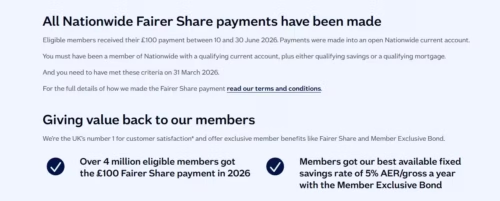
Nationwide’s official Fairer Share payment update and information for eligible members.
What Is the Nationwide Fairer Share Payment?
The Nationwide Fairer Share payment is a financial reward designed to distribute a portion of the building society’s profits directly to eligible members.
Unlike conventional shareholder-owned banks, Nationwide operates as a mutual building society.
Its members have an ownership interest in the organisation, allowing Nationwide to return financial value through customer rewards, competitive interest rates and member-exclusive products.
The Fairer Share initiative specifically rewards customers who maintain a broader financial relationship with the building society rather than simply holding an inactive account.
Historically, qualifying members have needed a suitable current account alongside either eligible savings or a residential mortgage.
The payment differs from several other banking incentives.
| Financial reward | How it works |
| Fairer Share payment | Discretionary profit-sharing reward for eligible members |
| Bank switching bonus | Incentive for transferring a current account |
| Savings interest | Return earned on deposited money |
| Cashback | Reward linked to eligible spending |
| Member-exclusive bond | Savings product available to qualifying members |
| Government support payment | Financial assistance provided through public schemes |
Fairer Share is not a government benefit, an ordinary savings interest payment or a guaranteed annual entitlement.
How Much Has Nationwide Paid Through the Fairer Share Scheme?
Since launching the initiative in 2023, Nationwide has progressively increased the overall amount distributed to members.
Although individual payments have remained at £100, the number of recipients and total financial commitment have increased.
Nationwide Fairer Share Payment History
| Year | Individual payment | Approximate recipients | Total distribution |
| 2023 | £100 | 3.44 million | £344 million |
| 2024 | £100 | 3.85 million | £385 million |
| 2025 | £100 | 4.09 million | £409 million |
| 2026 | £100 | 4.40 million | £440 million |
| 2027 | Not confirmed | Not confirmed | Not confirmed |
Historical distribution figures are based on reported financial results. Recipient numbers are approximate.
The total amount distributed increased by approximately 27.9% between 2023 and 2026, demonstrating the expanding reach of the programme.
Across the four payment cycles, a member who qualified every year would have received £400. If another £100 payment is approved in 2027, that cumulative figure could increase to £500.
What Do Nationwide’s Latest Financial Results Reveal About the 2027 Payment?
Nationwide’s financial results are particularly important because the Fairer Share scheme depends on the organisation’s ability to reward members while maintaining sufficient financial strength.
The interim results published in November 2026, covering the six months ending 30 September 2026, showed continued growth across several areas of the business.
| Financial indicator | Latest reported figure |
| Statutory profit before tax | £673 million |
| Previous comparable statutory profit | £486 million |
| Statutory profit growth | Approximately 38.5% |
| Total member value delivered | £1.4 billion |
| Fairer Share distribution | £440 million |
| Retail deposit balances | £279 billion |
| Residential mortgage balances | £294.1 billion |
The increase in profitability is an encouraging indicator for members hoping to receive another reward.
Nevertheless, Nationwide must also consider regulatory capital requirements, Virgin Money integration costs, economic conditions and future lending risks before approving another distribution.
During the May 2026 announcement, Dame Debbie Crosbie, Chief Executive of Nationwide, stated:
“More people than ever are choosing Nationwide.”
She also explained that growth across the society’s mortgage, savings and current account businesses supported its ability to reward eligible members.
Her comments demonstrate the relationship between commercial performance and the organisation’s mutual ownership model. However, they should not be interpreted as confirmation of a 2027 payment.
Who Could Qualify for the Nationwide Fairer Share Payment in 2027?
Nationwide is expected to publish a new set of eligibility requirements if another payment is approved.
Previous distributions required customers to hold a qualifying current account alongside a suitable savings or mortgage product.
Based on the 2026 requirements, the following account combinations could help customers understand their potential eligibility.
| Account combination | Potential eligibility under previous rules |
| Current account and £100 in qualifying savings | Eligible |
| Current account and qualifying residential mortgage | Eligible |
| Current account, savings and mortgage | Eligible for one payment |
| Current account only | Not eligible |
| Savings account only | Not eligible |
| Residential mortgage only | Not eligible |
| Current account and cash ISA with qualifying balance | Eligible |
| Current account and stocks and shares ISA only | Not eligible |
| Business savings account only | Not eligible |
| Qualifying joint current account and joint mortgage | Both members could qualify |
Basic Membership Requirements
Customers preparing for a possible 2027 payment should consider maintaining an active personal banking relationship with Nationwide, reviewing their savings arrangements and keeping their account information up to date.
However, opening an account does not automatically guarantee eligibility. The eventual 2027 terms will determine which customers qualify.
Which Nationwide Current Accounts Could Qualify for the £100 Payment?
Nationwide offers several personal current accounts, each designed for different financial circumstances.
Historically, the Fairer Share qualification conditions have varied depending on the account type.
| Current account | Historical 2026 requirement |
| FlexAccount | Meet deposit and outgoing payment conditions, or complete an eligible switch |
| FlexDirect | Meet account activity conditions, or complete an eligible switch |
| FlexBasic | Meet qualifying transaction conditions, or complete an eligible switch |
| FlexPlus | Pay the applicable monthly account fee |
| FlexOne | Complete qualifying account activity or an eligible switch |
| FlexStudent | Complete qualifying account activity or an eligible switch |
| FlexGraduate | Complete qualifying account activity |
Understanding the £500 Deposit Requirement
For FlexAccount, FlexDirect and FlexBasic customers, one of the previous qualification routes required at least £500 in incoming payments and two outgoing payments during each of two qualifying months.
An alternative route involved making at least ten outgoing payments in each of two qualifying months.
Transfers from another Nationwide account did not count towards the £500 incoming-payment requirement.
Customers should pay particular attention to their monthly activity rather than assuming that maintaining a high current account balance will automatically make them eligible.
How Did the Previous Monthly Transaction Rules Work?
One commonly misunderstood element of the Fairer Share scheme is that the different account activity routes cannot necessarily be combined.
The following examples illustrate how the 2026 requirements operated.
| January activity | February activity | March activity | Previous activity test |
| £500 received and two payments made | £500 received and two payments made | No activity | Passed |
| Ten outgoing payments | No activity | Ten outgoing payments | Passed |
| £500 received and two payments made | Ten outgoing payments | No activity | Failed |
| £500 received only | £500 received only | No activity | Failed |
| Five outgoing payments | Five outgoing payments | Five outgoing payments | Failed |
| Eligible completed account switch | No activity | No activity | Passed |
These examples assume that all relevant account and product conditions were otherwise satisfied.
The third example is particularly important. Meeting one transaction route in January and a different route in February did not satisfy the historical requirement.
This distinction could become relevant again if Nationwide retains similar conditions for 2027.
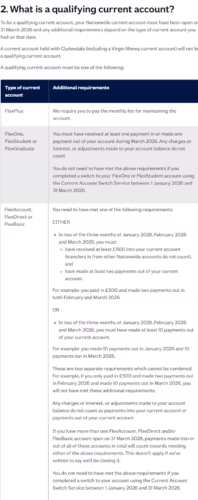
Nationwide Fairer Share qualifying current account requirements, including monthly deposits and outgoing transactions.
How Much Money Should Customers Keep in Nationwide Savings?
Under the 2026 scheme, customers could satisfy the savings requirement by holding a combined balance of at least £100 in eligible personal savings products or cash ISAs at the end of any day in March.
The amount did not necessarily need to be held in a single account.
| Personal savings balance | Cash ISA balance | Combined balance | Previous savings test |
| £100 | £0 | £100 | Passed |
| £50 | £50 | £100 | Passed |
| £75 | £50 | £125 | Passed |
| £40 | £40 | £80 | Failed |
| £0 | £150 | £150 | Passed |
| £500 in business savings only | £0 | £0 qualifying savings | Failed |
Customers should not confuse qualifying savings with money held in an ordinary current account or investment product.
Retired members may also benefit from comparing the best savings accounts for over 60s in the UK to determine whether their existing savings arrangements offer competitive returns.
While maintaining £100 in eligible savings could be a sensible preparation strategy, the final 2027 minimum balance remains unconfirmed.
Can Nationwide Mortgage Customers Receive the Fairer Share Payment?
Mortgage customers have historically been eligible for the Fairer Share scheme, provided they also hold a qualifying current account.
In 2026, customers needed an outstanding balance of at least £100 on an eligible Nationwide residential mortgage at the relevant assessment date.
Not every mortgage product was included.
| Mortgage circumstances | Previous mortgage eligibility |
| Standard Nationwide residential mortgage | Eligible |
| Joint Nationwide residential mortgage | Eligible |
| Residential mortgage with less than £100 outstanding | Not eligible |
| Fully repaid mortgage | Not eligible |
| Mortgage application awaiting completion | Not eligible |
| Standard buy-to-let mortgage | Not eligible |
| Commercial mortgage | Not eligible |
| Virgin Money mortgage | Excluded in 2026; potentially included in 2027 |
Homeowners should avoid delaying mortgage repayments purely to maintain possible Fairer Share eligibility.
The financial benefits of reducing mortgage interest and securing a competitive mortgage rate may outweigh a discretionary annual reward.
Will Virgin Money Customers Receive the Nationwide Fairer Share Payment in 2027?
The potential inclusion of Virgin Money customers represents one of the most important developments for the 2027 scheme.
Nationwide completed its acquisition of Virgin Money on 1 October 2024. A subsequent legal transfer took place on 2 April 2026, bringing relevant Virgin Money personal banking products under Nationwide Building Society.
The timing was significant because the 2026 Fairer Share eligibility assessment was based on 31 March 2026, two days before the legal transfer.
Consequently, Virgin Money products did not qualify independently for the 2026 distribution.
Virgin Money Eligibility Timeline
| Date | Development |
| 1 October 2024 | Nationwide completed its acquisition of Virgin Money |
| 31 March 2026 | Fairer Share eligibility assessment date |
| 2 April 2026 | Legal transfer of relevant Virgin Money accounts |
| May 2026 | Nationwide confirmed its fourth Fairer Share payment |
| June 2026 | Eligible Nationwide members received £100 |
| 2027 | Qualifying Virgin Money accounts could be included |
Nationwide has explicitly indicated that members with qualifying Virgin Money products could be included in a future 2027 distribution.
However, this does not mean every Virgin Money customer will automatically receive £100. The relevant account combinations, transaction requirements and payment arrangements remain subject to the new terms.
Customers should therefore avoid closing or transferring suitable products solely because of speculation surrounding the payment.
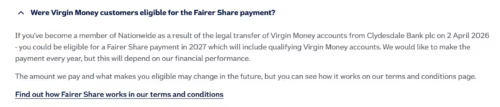
Nationwide confirms that qualifying Virgin Money accounts could be included in the 2027 Fairer Share scheme.
When Is the Nationwide Fairer Share Payment Expected in 2027?
Nationwide has historically announced its annual Fairer Share distribution alongside its full-year financial results, followed by payments during June.
In 2026, the announcement was made on 21 May, with payments distributed between 10 June and 30 June.
If the building society follows a similar schedule, members could expect the following provisional timeline.
| Expected period | Potential development |
| December 2026 | Customers review existing banking arrangements |
| January to March 2027 | Potential qualifying account activity period |
| 31 March 2027 | Possible eligibility assessment date |
| May 2027 | Potential announcement alongside financial results |
| Late May 2027 | Possible member notifications |
| June 2027 | Potential payment distribution |
These dates are estimates, not official commitments.
During the June 2026 distribution, more than four million payments were completed on the first day.
Commenting on the rollout, Stephen Noakes, Nationwide’s Group Retail Director, said:
“We’re pleased to be able to reward eligible members with £100 for the fourth consecutive year, reflecting Nationwide’s strong financial position.”
The statement reinforces the importance of financial strength in determining whether future distributions can take place.
Can Joint Account Holders Receive a Combined £200 Payment?
One of the advantages of the previous Fairer Share arrangements was that eligibility applied to individual members rather than simply to the number of accounts held.
This meant two eligible people sharing a joint current account and qualifying savings or mortgage could each receive £100.
| Household banking arrangement | Potential combined payment under previous rules |
| One eligible individual | £100 |
| Two independently eligible joint account holders | £200 |
| Joint current account with qualifying savings belonging to only one eligible member | £100 |
| Joint current account and qualifying joint mortgage | £200 |
| Two eligible partners with separate qualifying accounts | £200 |
| One person holding multiple qualifying accounts | £100 |
For example, a married couple holding a qualifying joint current account and £150 in joint savings could both satisfy the historical savings requirement, provided all remaining conditions were met.
Holding several qualifying accounts as an individual did not generate multiple rewards.
The distinction is important for households managing shared finances and considering the potential value of the scheme.
Will the Nationwide Fairer Share Payment Be Taxable in 2027?
Although eligible customers have historically received the full £100 directly into their current accounts, the payment is not necessarily tax-free.
Nationwide has previously classified Fairer Share payments as savings interest for UK income tax purposes and reported the relevant amounts to HM Revenue & Customs.
The actual tax liability depends on the recipient’s income, available Personal Savings Allowance and other applicable tax allowances.
Personal Savings Allowance for 2027–28
| Taxpayer category | Annual Personal Savings Allowance |
| Basic-rate taxpayer | £1,000 |
| Higher-rate taxpayer | £500 |
| Additional-rate taxpayer | £0 |
For many customers, the entire payment could remain tax-free because their total taxable savings interest falls within the applicable allowance.
However, the government’s Budget 2026 announcements proposed further changes to savings income tax rates from 6 April 2027.
Potential After-Tax Value of a £100 Payment
| Taxpayer category | Announced 2027–28 savings tax rate | Tax if entire payment is taxable | Net payment |
| Within available allowance | 0% | £0 | £100 |
| Basic-rate taxpayer | 24% | £24 | £76 |
| Higher-rate taxpayer | 44% | £44 | £56 |
| Additional-rate taxpayer | 49% | £49 | £51 |
The table assumes that the proposed rates take effect, the Fairer Share amount remains £100 and the entire payment falls outside any available tax-free allowances.
This is an important distinction because earlier financial articles may refer to lower savings tax rates that were announced before Budget 2026.
The latest government information is available in the official tax rates and allowances guidance.
Practical Tax Calculation Examples
| Other taxable savings interest | Fairer Share payment | Taxpayer category | Additional taxable interest |
| £600 | £100 | Basic rate | £0 |
| £950 | £100 | Basic rate | £50 |
| £450 | £100 | Higher rate | £50 |
| £500 | £100 | Higher rate | £100 |
| £1,200 | £100 | Basic rate | £100 |
For example, a basic-rate taxpayer earning £950 in other taxable savings interest would reach £1,050 after receiving a £100 Fairer Share payment.
Assuming no other available allowances and a 24% savings tax rate, the additional £50 would generate a £12 tax liability, leaving an effective £88 reward.
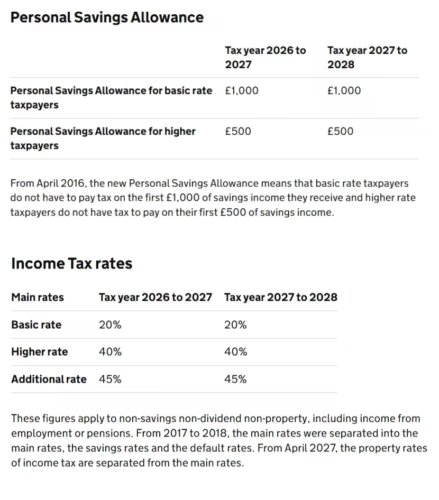
Government savings income tax rates and Personal Savings Allowance applicable to the 2027–28 tax year.
Could the Fairer Share Payment Affect Universal Credit or Other Benefits?
The Fairer Share payment is not a Department for Work and Pensions benefit. Receiving it does not automatically mean that a person’s benefits will stop.
However, customers receiving means-tested financial assistance should consider how the money contributes to their overall savings and capital.
For Universal Credit, household capital is generally assessed using the following thresholds, subject to applicable disregards and exceptions.
| Household capital | General Universal Credit treatment |
| £6,000 or less | Normally no capital-related reduction |
| Above £6,000 and up to £16,000 | Tariff income may reduce payments |
| Above £16,000 | Generally not eligible |
A £100 reward is unlikely to create a significant issue for someone whose savings are well below the relevant threshold. Nevertheless, it could become relevant for households already close to a capital limit.
Understanding what benefits you can claim if you have savings is particularly important for customers receiving means-tested financial assistance.
Recipients should check the treatment of the payment under their specific benefit rules rather than assuming it is automatically disregarded.
How Can Customers Prepare for a Possible Nationwide Fairer Share Payment?
Although the 2027 requirements remain unpublished, existing members can review their banking arrangements in advance.
Nationwide Fairer Share Preparation Checklist
- Maintain a suitable personal current account.
- Use the account regularly for normal financial transactions.
- Review qualifying personal savings and cash ISA balances.
- Keep account contact information accurate.
- Review mortgage arrangements where applicable.
- Retain relevant bank statements and transaction records.
- Check the official 2027 terms once published.
- Avoid closing an account before understanding the payment conditions.
Customers should particularly avoid waiting until the final days of March 2027 to review their accounts.
If Nationwide retains a multi-month activity requirement, last-minute transactions may not be sufficient to qualify.
Is It Worth Switching to Nationwide Just for the Fairer Share Payment?
From a personal finance perspective, switching banks solely to receive a potential £100 reward may not always be the most financially effective decision.
Customers should evaluate the wider benefits of the account, including interest rates, monthly fees, overdraft costs, savings products and customer service.
Consider a hypothetical comparison involving £10,000 in savings.
| Financial benefit | Nationwide example | Alternative provider |
| Illustrative savings interest rate | 3.5% | 4.8% |
| Annual savings interest | £350 | £480 |
| Potential Fairer Share payment | £100 | £0 |
| Total annual gross return | £450 | £480 |
These are illustrative interest rates, not current advertised banking offers.
Despite including a possible Fairer Share payment, the alternative provider produces £30 more in this example.
Similarly, an account charging £15 a month would cost £180 annually. A £100 reward would cover only approximately 55.6% of that cost, although the account’s other benefits could still make it worthwhile.
The most effective approach is to evaluate the entire banking relationship instead of treating the Fairer Share payment as the primary reason for opening an account.
Why Might Some Nationwide Customers Miss Out on the Payment?
Even customers who have banked with Nationwide for many years may fail to satisfy the specific qualification conditions.
The reward is not based solely on how long an individual has been a member.
Common potential reasons for exclusion include insufficient account activity, holding an ineligible savings product, missing the assessment date or closing the receiving current account before the distribution.
Common Eligibility Mistakes
| Customer mistake | Potential consequence |
| Holding only a current account | Missing the additional product requirement |
| Maintaining an inactive account | Failing the activity test |
| Holding savings below the minimum balance | Failing the savings test |
| Holding only investment products | Savings may not qualify |
| Opening an account after the deadline | Missing the assessment period |
| Combining different monthly transaction routes | Failing the activity requirements |
| Closing the receiving current account | Payment cannot be credited |
| Assuming membership guarantees payment | Unexpected exclusion |
Customers who narrowly miss one requirement may not receive a partial reward. Under previous arrangements, the standard £100 payment was available only to those meeting the relevant conditions.
How Will Nationwide Make the Fairer Share Payment?
Previous distributions were processed automatically through an electronic transfer into an eligible member’s open Nationwide current account.
Customers did not need to submit an application or complete a separate registration form.
The transaction appeared on bank statements as:
Nationwide Fairer Share Payment
Members with multiple current accounts may need to check each account, as the payment might not arrive in the account they use most frequently.
Payment arrangements involving Virgin Money accounts will need to be clarified in the 2027 terms.
What Should Customers Do if They Do Not Receive Their Fairer Share Payment?
Customers who believe they have been wrongly excluded should first review the eligibility conditions applicable to that particular year.
They should then examine their current account activity, savings balances and mortgage information before contacting Nationwide.
| Contact method | Available support |
| Telephone | 03457 30 20 11 |
| Mobile banking app | Secure customer support |
| Internet banking | Online account assistance |
| Nationwide branch | Face-to-face support |
| Official website | Fairer Share guidance and contact options |
Nationwide has previously confirmed that it will correct wrongly excluded payments when inaccurate or incomplete information has resulted in an eligible member missing out.
Customers should retain their bank statements and any relevant communications to support their enquiry.
How Can Customers Avoid Nationwide Fairer Share Payment Scams?
The popularity of the £100 reward could create opportunities for criminals to send fraudulent emails, text messages and misleading payment notifications.
A legitimate automatic payment should not require customers to disclose sensitive banking information or pay a processing fee.
Be cautious of messages requesting a banking PIN, online banking password, one-time security code, advance payment or transfer to another account.
Customers should access their Nationwide account directly through the official banking app or website rather than following links in unexpected messages.
If a communication claims that customers must urgently register to receive a Fairer Share payment, its legitimacy should be independently verified before taking any action.
Could Nationwide Increase the Fairer Share Payment Beyond £100 in 2027?
Although Nationwide has maintained the individual reward at £100 since 2023, future payment amounts could change.
The integration of Virgin Money may increase the number of potentially qualifying members, which would also increase the overall cost of maintaining a £100 distribution.
The following hypothetical scenarios demonstrate the financial scale of different payment amounts.
| Eligible members | Individual payment | Total distribution |
| 4.4 million | £100 | £440 million |
| 5 million | £100 | £500 million |
| 6 million | £100 | £600 million |
| 7 million | £100 | £700 million |
| 5 million | £125 | £625 million |
| 6 million | £150 | £900 million |
These figures are illustrative financial scenarios, not forecasts of Nationwide’s actual distribution.
For example, increasing the number of eligible recipients from 4.4 million to 6 million while maintaining a £100 reward would increase the total distribution cost by approximately 36.4%.
Our analysis suggests that broader eligibility could become a more significant development than an increase in the individual payment amount. However, Nationwide has not yet announced its intentions for the 2027 distribution.
How Does the Fairer Share Scheme Differ From the Big Nationwide Thank You?
Customers may occasionally confuse the Fairer Share payment with the separate Big Nationwide Thank You initiative.
The latter was introduced in 2025 as a special £50 reward following Nationwide’s acquisition of Virgin Money.
| Feature | Fairer Share payment | Big Nationwide Thank You |
| Historical individual amount | £100 | £50 |
| Main purpose | Sharing financial performance with eligible members | Recognising members following the acquisition |
| Frequency | Discretionary annual scheme | Special one-off initiative |
| Eligibility | Qualifying product combinations | Separate membership criteria |
| Guaranteed future payment | No | No |
Receiving the Big Nationwide Thank You payment did not automatically qualify a customer for Fairer Share.
Likewise, customers should not assume that Nationwide will offer both rewards in 2027.
Frequently Asked Questions
Is the Nationwide £100 Fairer Share payment confirmed for 2027?
No. Nationwide has not officially approved or announced the 2027 payment as of 28 November 2026. Further information could become available alongside its annual financial results.
When will Nationwide announce the 2027 Fairer Share payment?
Based on previous announcement schedules, May 2027 is a reasonable expectation. However, Nationwide has not confirmed an official announcement date.
Do I need £100 in savings to receive the Fairer Share payment?
Previous schemes required at least £100 in qualifying savings or an eligible residential mortgage alongside a qualifying current account. The 2027 requirements remain unconfirmed.
Will Virgin Money customers qualify for the 2027 payment?
Nationwide has indicated that qualifying Virgin Money accounts could be included in the 2027 scheme. Individual eligibility will depend on the officially published conditions.
Can pensioners receive the Nationwide Fairer Share payment?
Yes, pensioners could receive the payment if they satisfy the relevant eligibility requirements. The scheme is not restricted to customers of working age.
Can I receive two Fairer Share payments if I have multiple accounts?
Under previous rules, each eligible individual could receive only one payment, regardless of how many qualifying accounts they held.
Do I have to apply for the Nationwide £100 payment?
Previous payments were issued automatically to eligible members. Nationwide is expected to explain the application or payment process when the 2027 scheme is announced.
Can Nationwide stop the Fairer Share scheme?
Yes. The payment is discretionary and depends on financial performance, affordability and board approval. It is not a guaranteed annual entitlement.
