



Post Contents
Secured loans in the UK may help homeowners borrow larger amounts by using their property as security, but they come with serious risk. They can be useful for home improvements, debt consolidation or major expenses, but borrowers should compare APRC, fees, loan terms, affordability checks and FCA authorisation before applying.
Because missed repayments could put the home at risk, a secured loan should only be considered after comparing safer alternatives such as personal loans, unsecured loans or free debt advice. This is informational, not financial advice.
What Is a Secured Loan in the UK?

A secured loan is a type of borrowing where the lender uses an asset as security for the loan. In many UK cases, this asset is the borrower’s home, which is why secured loans are often described as homeowner loans, second-charge mortgages or second mortgages.
The security gives the lender a legal claim over the asset if the borrower fails to repay. This can make secured loans available for larger amounts or longer repayment terms, but it also increases the borrower’s risk.
Citizens Advice explains that secured loans on a home may be called a second mortgage, second charge or further charge, and lenders can have rights linked to repossession if repayments are not maintained.
A secured loan should not be judged only by the monthly repayment. Borrowers should check the total amount repayable, APRC, fees, loan term and whether the loan remains affordable if their income changes.
What Are the Requirements for Secured Loans in the UK?
The exact requirements vary by lender, but most secured loan providers will look at the borrower’s property, income, credit history and affordability before making a decision. Being a homeowner does not automatically mean approval, because lenders still need to check whether the repayments are realistic.
Common secured loan requirements include:
- Being aged 18 or over.
- Owning a property or having enough equity in the property.
- Having proof of income, employment or regular earnings.
- Passing credit and affordability checks.
- Providing property and mortgage details.
- Agreeing to a valuation or property assessment where required.
- Showing that the loan remains affordable after existing debts and household costs.
Applicants with poor credit may still find some specialist options, but the cost can be higher. Readers with weaker credit histories may also want to compare loans for bad credit before applying, as rates, fees and eligibility can vary widely.
What Are the Benefits of Secured Loans?
Secured loans can be useful for some UK borrowers, especially homeowners who need to borrow a larger amount than they could access through a standard unsecured loan. Because the borrowing is backed by an asset, lenders may offer higher loan limits or longer repayment terms.
The main benefits can include:
- Access to larger borrowing amounts, depending on equity and affordability.
- Longer repayment terms compared with many unsecured loans.
- Possible access for borrowers with less-than-perfect credit.
- Fixed or variable rate options, depending on the lender.
- Potential use for home improvements, major expenses or debt consolidation.
However, these benefits need to be weighed against the risk. A lower monthly payment over a longer term can still cost more overall if interest builds up for many years.
Borrowers comparing this option should also check low interest personal loans because unsecured borrowing may be safer for those who qualify.
What Are the Main Risks of Secured Loans?

The main risk of a secured loan is that the borrower’s home or asset may be at risk if repayments are not kept up. This makes secured borrowing more serious than an unsecured personal loan, especially for people consolidating existing debts.
Borrowers should also watch out for:
- Higher total interest if the loan is spread over many years.
- Broker fees, arrangement fees or valuation fees.
- Early repayment charges.
- Variable rates that could increase monthly payments.
- The risk of turning unsecured debts into property-secured debt.
- Damage to credit score if payments are missed.
The FCA warned in March 2026 that some second-charge mortgage firms needed to improve how they advised customers, assessed affordability and charged fees, especially where borrowers were consolidating debt. This makes it important to check whether the loan is genuinely suitable, not just whether it is available.
Borrowers using a secured loan to combine debts should also read about debt consolidation loans for bad credit before deciding whether this is the safest option.
How Should You Compare Secured Loan Lenders?
Before choosing a secured loan lender or broker, compare more than just the advertised rate. The best lender for one borrower may not be suitable for another because secured loans depend on property value, mortgage balance, credit history, income and the purpose of borrowing.
Use these checks before applying:
| What to Compare | Why It Matters |
| APRC | Shows the broader annual cost of borrowing, including interest and some charges. |
| Total amount repayable | Helps show the real long-term cost, not just the monthly payment. |
| Loan term | A longer term can reduce monthly payments but increase total interest. |
| Fees | Broker, arrangement, valuation and early repayment fees can change the total cost. |
| Eligibility | Some lenders only accept certain property types, credit profiles or income levels. |
| FCA status | Borrowers should check whether the firm is authorised and has permission for the service. |
| Debt consolidation suitability | Consolidating debt into a secured loan can increase risk if repayments become unaffordable. |
This table should be used as a practical checklist before contacting any provider.
Best Secured Loans in the UK: Top Lenders and Brokers to Compare
The lenders and brokers below may be considered by UK borrowers looking for secured loan options, but readers should not choose based on brand name alone.
Before applying, check each provider’s latest APRC, fees, loan terms, eligibility rules, customer reviews and FCA authorisation.
This list should be treated as a comparison starting point, not a personal recommendation. Secured loan rates and criteria can change, so borrowers should confirm the latest details directly with the provider before making a decision.
1. Proper Finance

Proper Finance is a UK loan comparison website that introduces applicants to lender and broker partners for secured loans and other borrowing products.
As of July 2026, its secured-loans page says rates start from 6.5% APR, with borrowing secured against property, a vehicle or another valuable asset. Proper Finance states that it works with Lending Expert and broker partners to help customers compare options across a panel of lenders.
Proper Finance is not a direct lender. Its website says Proper Finance is a trading style of Lending Expert Limited, which is authorised and regulated by the Financial Conduct Authority under FCA number 734116.
It also says applications made through the website may be introduced to partners and that commission may be received from lenders if finance is arranged.
This provider may be more relevant for homeowners who want to compare secured-loan options, including applicants with bad credit, self-employed income or larger borrowing needs. However, borrowers should not rely only on the advertised starting rate.
They should check the final APRC, broker fees, lender fees, early repayment charges, total amount repayable and whether the loan is affordable over the full term.
Proper Finance Updated Information Table
| Factor | Updated Information as of July 2026 | What Readers Should Check |
| Provider type | Loan comparison website / broker-style introducer, not a direct lender | Confirm who the actual lender or broker is before signing |
| Secured loan availability | Offers access to secured-loan options through lender and broker partners | Check whether the loan is secured against your home or another asset |
| Advertised rate | Proper Finance states rates start from 6.5% APR | The actual rate may be higher depending on credit profile, equity, income and affordability |
| Borrowing amount | Proper Finance promotes large secured borrowing options, with its site also referencing loans from £1,000 to £500,000 across products | Confirm the minimum and maximum secured-loan amount for your case |
| Loan purpose | May be used for home improvements, debt consolidation, business needs, car purchase, weddings, funerals or other major costs | Check whether your chosen lender allows your intended loan purpose |
| Eligibility | Usually depends on age, UK residency, income, affordability, credit history and available security | Bad credit may be considered, but this can increase the cost |
| FCA status | Proper Finance says it is a trading style of Lending Expert Limited, FCA number 734116 | Use the FCA Firm Checker before applying |
| Fees | Proper Finance says there are no upfront application fees, but lender, broker or arrangement fees may apply | Ask for the full fee breakdown and total repayable amount |
| Main risk | Property or another asset may be at risk if repayments are missed | Do not use secured borrowing unless repayments are affordable |
Before applying through Proper Finance, borrowers should confirm the final APRC, total repayable amount, lender details, broker fees and FCA authorisation. A secured loan can put the borrower’s home or other asset at risk if repayments are not maintained.
2. Lending Expert

Lending Expert is a UK credit broker and loan comparison service that helps borrowers compare secured loans, second-charge mortgages and other finance products through a panel of lenders and brokers.
As of July 2026, Lending Expert’s website says it is a credit broker, not a lender, and that finance is subject to status and income. It also states that Lending Expert Limited is authorised and regulated by the Financial Conduct Authority under FCA number 734116.
For secured borrowing, Lending Expert may be useful for homeowners who want to compare options for debt consolidation, home improvements, large expenses or capital raising without approaching each lender separately.
Its homeowner-loan information says it can consider different credit profiles and compare options from a wider lender panel, but borrowers should still check the final APRC, broker fee, lender fee and total amount repayable before applying.
Lending Expert also highlights that borrowers should think carefully before securing debts against their home, because the home may be repossessed if repayments are not kept up.
This warning is important if the loan is being used to consolidate existing debts, as extending the term may increase the total amount repaid.
Lending Expert Updated Information Table
| Factor | Updated Information as of July 2026 | What Readers Should Check |
| Provider type | Credit broker / comparison service, not a direct lender | Confirm the actual lender before accepting any offer |
| Main products | Secured loans, second-charge mortgages, homeowner loans and other finance options | Check whether the product is secured against your home |
| FCA status | Lending Expert Limited states it is FCA authorised and regulated under FCA number 734116 | Verify the firm on the FCA Firm Checker before applying |
| Contact number | Lending Expert pages continue to show 0161 820 8099 for enquiries | Confirm contact details directly from the current website |
| Representative example | Lending Expert Money shows an example of borrowing £18,000 over 120 months, with 9.1% APRC, broker fee £1,530 and lender fee £495 | Do not assume this is the rate you will receive; your offer may differ |
| Fees | Broker and lender fees may apply depending on the loan and provider | Ask for all fees in writing before proceeding |
| Credit profile | Some Lending Expert pages say different credit types may be considered | Bad credit may increase the rate and reduce lender choice |
| Common loan uses | Debt consolidation, home improvements, business investment, tax bills, school fees or other major expenses | Make sure the loan purpose is accepted by the lender |
| Main risk | The loan may be secured against your home | Missed repayments could put your home at risk |
Before applying through Lending Expert, borrowers should check the final lender name, APRC, total amount repayable, broker fee, lender fee, early repayment charges and FCA authorisation. A secured loan should only be considered if the repayments are affordable over the full term.
3. Santander
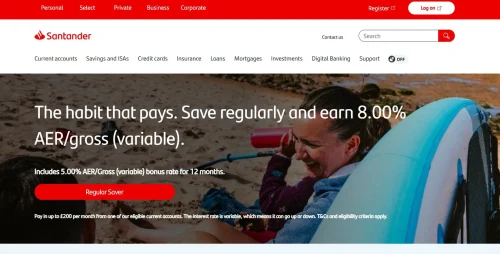
Santander UK is a major high-street bank offering personal loans, mortgages and additional borrowing options. As of July 2026, Santander’s standard personal-loan product is unsecured, with rates advertised from 6.4% APR representative on loans from £7,500 to £25,000. This means the usual Santander personal loan should not be described as a secured loan.
For secured borrowing, Santander’s relevant option is additional borrowing for existing Santander mortgage customers.
Santander says existing mortgage customers may be able to apply for an additional loan secured against their property if they want to borrow at least £5,000, borrow for at least 5 years, and keep total borrowing below 90% of the home’s value, including the current mortgage and the additional loan.
Santander may therefore suit readers who already have a Santander mortgage and want to raise extra funds through their property. However, it may not be suitable for readers looking for a standalone secured loan from a broker panel or a second-charge loan from a specialist lender.
Before applying, borrowers should check the product type, APRC, fees, loan-to-value limit, early repayment charges and whether the additional borrowing is affordable over the full mortgage term.
Santander Updated Information Table
| Factor | Updated Information as of July 2026 | What Readers Should Check |
| Provider type | Major UK bank and mortgage lender | Confirm whether the product is a personal loan, mortgage additional borrowing or another mortgage product |
| Standard personal loan | Santander’s standard personal loans are unsecured | Do not present Santander’s personal loan as a secured loan |
| Secured borrowing route | Existing Santander mortgage customers may apply for additional borrowing secured against their property | Check if you already have a Santander mortgage and meet the criteria |
| Minimum additional borrowing | Santander states additional borrowing must be at least £5,000 | Confirm the latest minimum borrowing amount before applying |
| Minimum term | Santander states the money must be borrowed for at least 5 years | A longer term may lower monthly payments but increase total interest |
| Loan-to-value limit | Total borrowing must be below 90% of the home’s value, including the existing mortgage and additional loan | Check your current mortgage balance, property value and available equity |
| Bankruptcy / IVA rule | Santander says applicants must not have been declared bankrupt or be subject to an Individual Voluntary Arrangement | Check eligibility before applying |
| Contact note | The old 0333 207 2229 number is mainly shown for Santander Corporate & Commercial services, not personal secured borrowing | Use the current Santander mortgage/additional-borrowing page for contact details |
| Main risk | Additional borrowing is secured against the property | Missed repayments could put the home at risk |
Before applying for Santander additional borrowing, borrowers should confirm the latest rate, APRC, product fee, valuation or legal costs, early repayment charges and total amount repayable.
Santander’s secured borrowing route is best described as mortgage additional borrowing for eligible existing Santander mortgage customers, not a general secured-loan product for all homeowners.
4. Norton Finance

Norton Finance is a UK credit broker that helps borrowers compare homeowner loans, secured loans, remortgages and other finance options through a selected panel of lenders.
As of July 2026, Norton Finance says it is a broker, not a bank or direct lender, and that it may receive commission from lenders if a customer takes out a loan through its service.
For secured loans, Norton Finance may be suitable for homeowners who want to compare borrowing options for debt consolidation, home improvements or other major expenses.
Its homeowner-loan information says secured-loan rates start from 5.69% variable, with a representative example showing 11.3% APRC variable. However, the final rate depends on the borrower’s credit profile, property, affordability, loan amount and lender criteria.
Borrowers should be careful with fees. Norton Finance says a broker fee of up to 12.5% of the loan amount may be charged, capped at £4,950, and lender fees may also apply. This means the total cost can be higher than the advertised rate suggests, especially if the loan is taken over a long term.
Norton Finance may be relevant for borrowers who have struggled to get accepted by traditional lenders, but it should not be treated as a guaranteed approval option.
Before applying, borrowers should check the APRC, total amount repayable, broker fee, lender fee, early repayment charges and whether the repayments are affordable over the full term.
Norton Finance Updated Information Table
| Factor | Updated Information as of July 2026 | What Readers Should Check |
| Provider type | Credit broker, not a bank or direct lender | Confirm the actual lender before accepting an offer |
| Main secured product | Homeowner loans / secured loans arranged through a lender panel | Check whether the loan is secured against your property |
| Advertised secured-loan rate | Rates start from 5.69% variable | The final rate may be higher depending on credit profile and affordability |
| Representative APRC | Norton Finance shows a representative 11.3% APRC variable example | Compare APRC, not just the starting rate |
| Broker fee | Up to 12.5% of the loan amount, capped at £4,950 | Ask whether the broker fee is added to the loan or paid separately |
| Lender fee | Lender fees may also apply | Request the full fee breakdown before signing |
| Credit profile | Norton Finance says it has plans for a range of credit problems | Bad credit may increase the APRC and reduce available options |
| Loan uses | Debt consolidation, home improvements and other major borrowing needs | Check whether your chosen lender accepts the loan purpose |
| Contact number | Norton Finance lists 0800 694 5566 for enquiries | Confirm contact details from the current Norton Finance website |
| Main risk | Loans are secured on property | Your home may be repossessed if repayments are not kept up |
Before applying through Norton Finance, borrowers should confirm the actual lender, final APRC, broker fee, lender fee, early repayment charges and total repayable amount.
If the loan is being used to consolidate existing borrowing, the borrower may be extending the debt term and increasing the total amount repaid.
5. NatWest

NatWest is a major UK bank offering personal loans, mortgages and additional borrowing options. As of July 2026, NatWest’s standard personal-loan page advertises 6.9% APR representative for loans between £7,500 and £14,950, but these are standard bank loans and should not be presented as secured loans. NatWest says the rate depends on the customer’s circumstances and loan amount.
For property-secured borrowing, the more relevant NatWest option is additional borrowing on an existing NatWest mortgage.
NatWest says existing mortgage customers can apply to borrow extra money on their current mortgage for a clear purpose, and the extra borrowing is added to the usual monthly mortgage payment. NatWest also states that the extra borrowing is secured against the home.
NatWest may be suitable for readers who already have a NatWest residential mortgage and want to raise extra funds for home improvements, debt consolidation, a car, a second property or another approved purpose.
However, it is not the same as a standalone secured-loan broker panel. Borrowers should check the APRC, mortgage rate, set-up fee, total amount repayable, loan-to-value, repayment term and whether the borrowing remains affordable over the full mortgage period.
NatWest Updated Information Table
| Factor | Updated Information as of July 2026 | What Readers Should Check |
| Provider type | Major UK bank and mortgage lender | Confirm whether the product is a personal loan, mortgage additional borrowing or another mortgage product |
| Standard personal loan | NatWest advertises 6.9% APR representative for loans from £7,500 to £14,950 | Standard NatWest personal loans should not be described as secured loans |
| Secured borrowing route | Existing NatWest mortgage customers may apply for additional borrowing on their mortgage | Check whether you already have a NatWest mortgage and meet the criteria |
| Security | NatWest says additional borrowing is secured against the home | Missed repayments could put the property at risk |
| Borrowing limit | NatWest says residential mortgage customers may be able to borrow up to 90% of the property’s value | Check your current mortgage balance, home value and available equity |
| Borrowing amount | NatWest says eligible customers can apply to borrow between £10,000 and £500,000 | Confirm the latest minimum and maximum amounts before applying |
| Term | NatWest says additional borrowing can run from 3 to 40 years, or until age 75, whichever comes first | A longer term can reduce monthly payments but increase total interest |
| Valuation fee | NatWest says it does not charge a valuation fee for additional borrowing | Check whether any set-up, product or legal fees apply |
| Eligibility | Applicants usually need a NatWest mortgage, UK residency, up-to-date mortgage payments and at least one payment made on the existing mortgage | Applications are still subject to underwriting and lending requirements |
| Contact number | NatWest lists 0345 302 0190 for its mortgage team | Use the current NatWest borrowing-more page for latest contact details |
| Main risk | Additional borrowing may extend the mortgage term and increase total interest | Think carefully before securing other debts against your home |
Before applying for NatWest additional borrowing, borrowers should confirm the latest mortgage rate, APRC, set-up fees, early repayment charges, total amount repayable and affordability position.
NatWest’s secured borrowing route is best described as additional mortgage borrowing for eligible existing mortgage customers, not a general secured-loan product for every borrower.
6. Barclays

Barclays is a major UK bank offering personal loans, mortgages and additional borrowing options. As of July 2026, Barclays advertises 6.8% APR representative on personal loans of £7,500 to £15,000 over 2 to 5 years, but this is a standard personal-loan product and should not be described as a secured loan.
For property-secured borrowing, the more relevant Barclays option is additional borrowing on an existing Barclays mortgage. Barclays says existing mortgage customers may be able to borrow more against their property through additional mortgage borrowing.
This can be used for larger costs such as home improvements, but it is different from a standalone secured loan arranged through a broker or specialist second-charge lender.
Barclays may suit readers who already have a Barclays mortgage and want to raise extra funds through their property. However, it may not be suitable for readers looking for a general secured-loan panel, bad-credit secured loan, or separate second-charge loan.
Borrowers should check the mortgage rate, APRC, product fees, total amount repayable, loan-to-value limit, early repayment charges and whether the extra borrowing remains affordable over the full mortgage term.
Barclays Updated Information Table
| Factor | Updated Information as of July 2026 | What Readers Should Check |
| Provider type | Major UK bank and mortgage lender | Confirm whether the product is a personal loan, mortgage additional borrowing or another mortgage product |
| Standard personal loan | Barclays advertises 6.8% APR representative for loans from £7,500 to £15,000 over 2 to 5 years | Standard Barclays personal loans should not be described as secured loans |
| Secured borrowing route | Existing Barclays mortgage customers may be able to apply for additional borrowing against their property | Check whether you already have a Barclays mortgage and meet the criteria |
| Product type | Additional mortgage borrowing / further advance | This is different from a standalone second-charge secured loan through a broker |
| Common uses | Barclays presents additional borrowing as a way to borrow more against property for planned costs | Confirm that your intended borrowing purpose is allowed |
| Eligibility | Depends on mortgage status, income, affordability, credit checks, property value and lending criteria | Approval is not guaranteed |
| Security | The additional borrowing is against the property | Missed repayments could put the home at risk |
| Fees | Product, valuation, legal or early repayment charges may apply depending on the mortgage deal | Ask for all fees and total repayable amount before accepting |
| Main alternative | An unsecured Barclays personal loan may be available for smaller borrowing needs | Compare unsecured borrowing before securing debt against your home |
| Contact note | The old 0345 734 5345 number is Barclays’ general personal banking number | Use the current Barclays mortgage/additional-borrowing page for the latest route |
Before applying for Barclays additional borrowing, borrowers should confirm the latest rate, APRC, fees, early repayment charges, loan-to-value position and total amount repayable.
Barclays is best described as offering mortgage additional borrowing for eligible existing mortgage customers, not a general secured-loan product for all homeowners.
7. RBS

Royal Bank of Scotland, commonly known as RBS, is a major UK bank offering personal loans, mortgages and additional borrowing options. As of July 2026, RBS says customers may be able to borrow from £1,000 to £50,000 through its personal-loan products, with repayment terms depending on the amount borrowed and the loan purpose.
However, these standard RBS personal loans should not be presented as secured loans because they are ordinary bank loans, not property-secured homeowner loans.
For property-secured borrowing, the more relevant RBS option is additional borrowing for existing RBS mortgage customers. RBS says the extra money is secured against the borrower’s home, added to the monthly mortgage payment, and may be available up to 90% of the property’s value for residential mortgages.
RBS also says additional borrowing can run from 3 to 40 years, while interest-only or buy-to-let borrowing has a maximum term of 35 years.
RBS may suit readers who already have an RBS mortgage and want to raise extra funds for an approved purpose, such as home improvements or another large expense.
However, it should not be described as a general secured-loan provider for all UK homeowners. Borrowers should check the mortgage rate, APRC, loan-to-value, repayment term, fees, early repayment charges and whether the extra borrowing remains affordable over the full mortgage period.
RBS Updated Information Table
| Factor | Updated Information as of July 2026 | What Readers Should Check |
| Provider type | Major UK bank and mortgage lender | Confirm whether the product is a personal loan, mortgage additional borrowing or another mortgage product |
| Standard personal loan | RBS says customers may be able to borrow from £1,000 to £50,000 | Standard RBS personal loans should not be described as secured loans |
| Personal-loan eligibility | Applicants usually need to be 18+, UK resident and an existing Royal Bank of Scotland customer | Check the current eligibility rules before applying |
| Secured borrowing route | Existing RBS mortgage customers may be able to borrow more on their mortgage | This is additional mortgage borrowing, not a standalone secured-loan panel |
| Security | RBS says the extra money is secured against the borrower’s home | Missed repayments could put the property at risk |
| Loan-to-value limit | RBS says residential mortgage customers may be able to borrow up to 90% of the property’s value | Check your current mortgage balance, home value and available equity |
| Repayment term | RBS says additional borrowing can run from 3 to 40 years; interest-only and buy-to-let borrowing can run up to 35 years | A longer term may reduce monthly payments but increase total interest |
| Valuation fee | RBS says it does not charge a valuation fee for additional borrowing | Ask whether any product, legal or arrangement fees apply |
| Repayment method | Extra borrowing is added to the monthly mortgage payment | Check the new monthly payment and total repayable amount |
| Main risk | The borrowing is secured against the home | Think carefully before securing debts against your property |
Before applying for RBS additional borrowing, borrowers should confirm the latest rate, APRC, fees, repayment term, loan-to-value position, early repayment charges and total amount repayable.
RBS is best described as offering additional mortgage borrowing for eligible existing mortgage customers, not a general secured-loan product for every borrower.
8. Evolution Money

Evolution Money is a UK secured-loan provider focused on homeowner loans. As of July 2026, Evolution Money says it offers secured homeowner loans from £5,000 to £105,000, with repayment terms from 3 to 20 years. Its secured loans are only available to homeowners with a mortgage on a property that can be used as collateral.
Evolution Money may be relevant for borrowers who want to raise money for debt consolidation, home improvements or other major expenses.
It says all credit profiles may be considered, but applicants still need to pass affordability checks and must be able to repay the loan by their 70th birthday.
Borrowers should be careful with the cost of borrowing. Evolution Money’s secured-loan page shows a representative example of 28.96% APRC variable, with a product fee and lending fee included in the total amount repayable.
The final rate, fees and repayment amount can vary depending on the borrower’s credit history, income, property, equity and affordability.
Evolution Money Limited says it is a licensed credit broker and service provider to Evolution Lending Limited. It also states that it is authorised and regulated by the Financial Conduct Authority under firm reference number 708324.
Evolution Money Updated Information Table
| Factor | Updated Information as of July 2026 | What Readers Should Check |
| Provider type | Secured homeowner-loan provider / licensed credit broker and service provider to Evolution Lending Limited | Confirm the actual lender and loan agreement before signing |
| Loan type | Secured homeowner loan | The loan is secured against property |
| Loan amount | £5,000 to £105,000 | Check the amount offered based on your equity, income and affordability |
| Repayment term | 3 to 20 years | A longer term may reduce monthly payments but increase total interest |
| Eligibility | Applicants must own a property, be aged 21 to 70, be UK residents and afford repayments | Check whether you meet the latest criteria before applying |
| Mortgage requirement | Evolution Money says applicants must be homeowners with a mortgage on a property used as collateral | Not suitable for non-homeowners |
| Credit profile | All credit profiles may be considered | Poor credit may increase the APRC and reduce available options |
| Representative APRC | Evolution Money shows 28.96% APRC variable on its secured-loan page | Compare APRC, not only the monthly payment |
| Fees | Product fee and lending fee may apply | Ask whether fees are added to the loan and how they affect the total amount repayable |
| FCA status | Evolution Money Limited states FCA firm reference number 708324 | Verify this through the FCA Firm Checker before applying |
| Main risk | The borrowing is secured against the borrower’s home | Missed repayments could put the home at risk |
Before applying with Evolution Money, borrowers should confirm the final APRC, product fee, lending fee, total repayable amount, early repayment charges and affordability position.
This provider may suit homeowners looking for specialist secured borrowing, but it should only be considered if repayments are affordable over the full loan term.
9. Willows Finance

Willows Finance is a UK secured-loan broker specialising in homeowner secured loans, mortgages and bridging finance.
As of July 2026, Willows Finance says homeowners can borrow from £10,000 to £500,000 through secured-loan options, with applications compared across a wide panel of lenders. It also says customers can request an initial quote without affecting their credit score.
Willows Finance should not be described as a direct lender. Its website states that Willows Finance is a credit broker, not a lender, and that it works with a representative panel of lenders.
It also states that Willows Finance Limited is authorised and regulated by the Financial Conduct Authority, with FCA register number 670052.
This broker may be relevant for homeowners who want to compare secured-loan options for debt consolidation, home improvements, bad credit, alternative income or more complex borrowing situations.
However, borrowers should still check the actual lender, final APRC, broker fee, lender fee, legal fees, early repayment charges and total amount repayable before proceeding.
Willows Finance also gives the standard secured-loan warning that loans are secured against property and that the property may be repossessed if repayments are not maintained.
This warning should be kept close to the lender description because it is important for YMYL compliance.
Willows Finance Updated Information Table
| Factor | Updated Information as of July 2026 | What Readers Should Check |
| Provider type | Secured-loan broker, not a direct lender | Confirm the actual lender before accepting an offer |
| Main products | Secured loans, mortgages and bridging finance | Check whether the product is a homeowner loan, remortgage or bridging loan |
| Secured-loan amount | Willows Finance says homeowners can borrow from £10,000 to £500,000 | The final amount depends on property value, equity, income and affordability |
| Credit check | Willows Finance says initial options can be checked without affecting credit score | Confirm when a hard credit search will be carried out |
| Lender panel | Compares options from a wide panel of lenders | Ask which lender is making the final offer |
| FCA status | Willows Finance Limited states FCA register number 670052 | Verify the firm on the FCA Firm Checker before applying |
| Fees | Broker, lender, legal or valuation fees may apply depending on the loan | Ask for all fees and whether they are paid upfront or added to the loan |
| Complex cases | May help with bad credit, debt consolidation, alternative income and other specialist cases | More complex cases may come with higher rates or stricter terms |
| Contact number | Current website contact number is 01656 766 158 | Replace the old 0800 783 8871 number with the current listed number |
| Main risk | Loans are secured against property | The property may be repossessed if repayments are not kept up |
Before applying through Willows Finance, borrowers should confirm the final lender, APRC, broker fees, lender fees, legal costs, early repayment charges and total amount repayable.
Willows Finance may suit homeowners who want broker support, but the loan should only be considered if repayments are affordable over the full term.
10. Pepper Money UK

Pepper Money UK is a specialist mortgage and second-charge lender offering homeowner loans, also known as secured loans or second-charge mortgages.
As of July 2026, Pepper Money says a homeowner loan allows borrowers to use their property as security while keeping their existing first mortgage in place. This means the borrowing is separate from the main mortgage but still secured against the home.
Pepper Money may be relevant for homeowners who want to release capital for debt consolidation, home improvements or other large borrowing needs.
Its broker-facing second-charge mortgage criteria say Pepper Money may offer second-charge mortgages from £5,000 to £1,000,000, with repayment periods of up to 40 years and a minimum property value of £75,000.
Pepper Money is also positioned as a specialist lender for cases that may not fit standard high-street criteria, including some borrowers with more complex credit, self-employed income, contractor income or rental profits.
However, applications are still subject to affordability checks, credit assessment and lending criteria. Pepper Money says the actual rate offered depends on the borrower’s individual circumstances.
Pepper Money operates through UK Mortgage Lending Ltd trading as Pepper Money, which states that it is authorised and regulated by the Financial Conduct Authority under registration number 710410 as a provider of regulated mortgages.
It is also a member of the Finance and Leasing Association and follows its Lending Code as a provider of second-charge regulated mortgages.
Pepper Money UK Updated Information Table
| Factor | Updated Information as of July 2026 | What Readers Should Check |
| Provider type | Specialist mortgage and second-charge lender | Check whether the application must go through a broker or intermediary |
| Product type | Homeowner loan / secured loan / second-charge mortgage | Confirm that the loan will be secured against the property |
| Loan amount | Pepper Money says second-charge mortgages may be available from £5,000 to £1,000,000 | The final amount depends on property value, equity, income and affordability |
| Repayment term | Broker criteria mention repayment periods up to 40 years | A longer term can reduce monthly payments but increase total interest |
| Property requirement | Minimum property value shown as £75,000 | Check whether your property type and location are accepted |
| Regional availability | Pepper Money says it does not currently lend for second-charge products in Northern Ireland, but does lend in mainland Scotland and some islands | Confirm availability for your postcode before applying |
| Credit assessment | Pepper Money says it uses Equifax credit reports when assessing mortgage applications | Credit history can affect acceptance, rate and terms |
| Rates | Pepper Money says it offers fixed, discounted and variable rate products, with the actual rate based on individual circumstances | Compare APRC, not only the headline or starting rate |
| Fees and ERCs | Broker criteria mention no-ERC products and no-valuation products are available | Ask whether your chosen product has valuation fees, product fees or early repayment charges |
| FCA status | UK Mortgage Lending Ltd t/a Pepper Money states FCA registration number 710410 | Verify authorisation through the FCA Firm Checker |
| Contact number | Pepper Money lists 03333 701 102 on its contact and customer-support pages | Use the current Pepper Money website for the latest contact route |
| Main risk | The loan is secured against the borrower’s home | The home may be repossessed if repayments are not kept up |
Before applying with Pepper Money UK, borrowers should confirm the final APRC, total amount repayable, product fees, valuation costs, early repayment charges, broker involvement and affordability position.
Pepper Money may suit homeowners who need specialist second-charge borrowing, but it should only be considered if repayments remain affordable for the full term.
Secured Loan Provider Overview
Before applying with this provider, check the latest APRC, total amount repayable, broker fees, early repayment charges and eligibility requirements. Also confirm the firm’s status through the FCA before sharing personal or financial details.
For FCA checking, use this sentence once after the lender list:
Borrowers can use the FCA Firm Checker to see whether a financial services firm is authorised and has permission to provide the products or services being offered.
What Are the Alternatives to a Secured Loan?

A secured loan is not the only option. Depending on the borrower’s credit score, income, property situation and reason for borrowing, another product may be cheaper or safer.
Possible alternatives include:
- An unsecured personal loan, especially for smaller borrowing amounts.
- A remortgage, if switching the main mortgage makes financial sense.
- A further advance from the existing mortgage lender.
- A 0% balance transfer card for suitable credit-card debt.
- A money transfer card for short-term borrowing.
- Free debt advice if the loan is mainly for debt consolidation.
Borrowers should compare unsecured loans, personal loans and low interest personal loans before choosing secured borrowing. The safest option is not always the one with the lowest monthly payment.
Conclusion
Secured loans in the UK can help homeowners access larger borrowing amounts, but they should be approached carefully.
They may be useful for home improvements, major expenses or debt consolidation, but the risk is higher because the loan is secured against an asset, usually the borrower’s home.
Before applying, compare APRC, fees, total repayment cost, loan term, affordability and alternatives. Borrowers should also check whether the lender or broker is authorised and whether the loan is genuinely suitable for their financial situation. This article is for general information only and is not financial advice.
FAQ
1. What is a secured loan in the UK?
A secured loan is borrowing backed by an asset, usually a home. If repayments are missed, the lender may have rights over the secured asset.
2. Are secured loans the same as homeowner loans?
Yes, many secured loans in the UK are also called homeowner loans because they are usually secured against the borrower’s property.
3. Can I get a secured loan with bad credit?
It may be possible, but borrowers with poor credit may face higher rates, stricter checks and fewer lender options.
4. What can a secured loan be used for?
Secured loans are often used for home improvements, debt consolidation, large purchases or major one-off costs, depending on lender rules.
5. Can I lose my home with a secured loan?
Yes. If the loan is secured against your home and repayments are not maintained, your property could be at risk.
6. What should I compare before applying?
Compare APRC, total amount repayable, loan term, fees, early repayment charges, affordability checks and FCA authorisation.
7. Is a secured loan better than an unsecured loan?
Not always. A secured loan may allow larger borrowing, but an unsecured loan may be safer because it does not usually place your home directly at risk.
Editorial Note:
This guide was last checked on 6 July 2026. Secured loan rates, fees, eligibility rules and lender availability can change. Readers should check the latest details directly with the lender or broker and confirm firm authorisation through the FCA before applying. This content is informational only and should not be treated as personal financial advice.
Source Links
MoneyHelper – Second charge or second mortgages
https://www.moneyhelper.org.uk/en/homes/buying-a-home/second-charge-or-second-mortgages
Citizens Advice – Mortgages and secured loans
FCA – FCA Firm Checker
https://www.fca.org.uk/consumers/fca-firm-checker
FCA – Second charge mortgage firms told to raise standards for consumers
