



Post Contents
There is no single UK-wide amount that you can deposit into every current account. If you are paying in physical cash, your limit depends on your bank, account type and deposit method.
A branch counter, Post Office counter and cash deposit machine can each have different restrictions, while electronic transfers are usually governed by separate rules.
It is also important to separate a cash deposit limit from the total amount you can hold in your account and from the amount protected if your bank or building society fails.
At a glance
- Cash deposit limits are set by individual providers rather than one universal UK figure.
- Daily, annual and rolling cash limits can operate at the same time.
- Paying in £10,000 or £20,000 may be possible, but your chosen deposit channel can restrict how you do it.
- Standard eligible deposit protection is currently up to £120,000 per person, per authorised firm.
Knowing which of these limits you are dealing with is the key to answering how much you can deposit in a current account.
Last Updated: 20.08.2026
Why Does Your Cash Deposit Limit Change Depending On How You Pay Money In?
Cash is handled differently depending on where you deposit it, so the same current account can have more than one practical paying-in limit.
Branch, Post Office And Cash-Machine Limits
A branch counter may be able to process a different amount from an ATM or cash deposit machine. One current-account provider, for example, allows up to £2,500 a day through its cash machines, while its wider official annual cash deposit rules set a £20,000 annual allowance for relevant personal accounts.
Can Your Bank Apply Daily And Annual Limits?
Yes. A £3,000 daily allowance does not necessarily mean you can deposit £3,000 every day indefinitely.
Some providers combine a daily cap with a rolling annual limit, meaning earlier cash deposits continue to count towards your available allowance until the relevant period expires.
Account-Specific Deposit Rules
Personal, joint, savings and business accounts can operate under different cash rules. One current policy gives sole customers a £20,000 annual allowance across relevant personal accounts while giving each joint account its own £20,000 allowance shared between the account holders.
You should therefore check both your account type and deposit channel before assuming a published figure applies to you.
Is There A Legal Maximum Cash Deposit For UK Current Accounts?
There is no evidence in the official material reviewed for this article of a single legal figure, such as £10,000, that acts as the maximum cash deposit for every UK personal current account. Instead, providers impose their own operational and financial-crime controls.
This distinction matters because a bank asking questions about a large deposit does not, by itself, mean that the amount is prohibited.
Providers may ask about the origin of cash, request supporting paperwork or apply additional checks when the transaction is unusually large or does not match your normal account activity.
One supplied official account page expressly says customers making large cash deposits may be asked where the money came from and for documentation supporting its source.
You should therefore avoid treating £10,000, £20,000 or any other commonly quoted figure as a universal UK legal threshold. Your provider’s current cash policy is the practical starting point.
How Much Can You Deposit With Major UK Banks And Through The Post Office?
Current provider rules demonstrate why one figure cannot accurately answer every UK cash-deposit query.
Examples of Current Cash-Deposit Rules
| Provider Or Channel | Current Cash Rule | What It Means |
| Nationwide | £20,000 annual cash limit across relevant sole personal current and savings accounts; £2,500 per day through its cash machines | Daily channel limits can sit inside a wider annual allowance |
| Royal Bank of Scotland | £3,000 per day at a branch counter | A branch can have its own daily restriction |
| NatWest | £3,000 daily and £24,000 rolling annual limit at a Post Office or CDM; £50,000 rolling annual branch-counter limit | Different channels can interact with an overall allowance |
| Post Office banking | The customer’s bank determines the applicable deposit limit | There is no single Post Office cash allowance for every personal bank account |
These figures come from current official provider material and can change when account policies change.
Why Can Post Office Limits Differ?
Paying cash in at a Post Office does not replace your bank’s own restrictions. The cofficial cash deposit service guidance confirms that participating banks determine the limits that apply to their customers.
The official wording is particularly clear: “Each bank sets its own limits for cash withdrawals and deposits.”
That means you should check your bank’s allowance rather than assuming your local counter can accept any amount.
Can You Deposit £10,000, £20,000 Or More Into A Current Account?
You may be able to put £10,000, £20,000 or more into a current account, but the method matters. Depositing that amount as physical cash is different from receiving the same amount electronically.
A £10,000 cash deposit may exceed your provider’s daily branch, Post Office or machine limit even where your account can hold substantially more than £10,000. A £20,000 payment could also use all or a substantial part of an annual cash allowance where one applies.
Trying to divide a large amount into smaller transactions does not necessarily solve the problem because cumulative daily or annual limits can still apply.
It can also make sense to contact the provider beforehand so you know which deposit route is accepted and what supporting information may be requested.
The key question is therefore not simply “Can my account hold £20,000?” but “How does my provider allow this particular £20,000 to be paid in?”
Why Might Your Bank Ask Where A Large Cash Deposit Came From?
Banks and building societies may carry out additional checks when a cash deposit is large, unusual or inconsistent with how an account is normally used. Current provider guidance links cash-deposit controls to protection against fraud and financial crime.
Source-Of-Funds Checks For Larger Deposits
A source-of-funds check is intended to establish where the money being deposited came from. Questions can therefore relate to both the origin of the cash and the way you normally use your account.
What Evidence Could Support Your Explanation?
What you need will depend on your circumstances and provider.
Potential Supporting Records
- A receipt or agreement for the sale of an asset.
- Probate or inheritance documentation where relevant.
- Invoices, transaction records or other payment evidence.
- Records showing where previously withdrawn or accumulated funds came from.
One supplied provider page specifically gives a receipt from another bank as an example of relevant paperwork when cash has previously been withdrawn elsewhere.
These examples are not a universal documentation checklist, so your bank may request different evidence.
Large Deposits And Account Checks
A request for information should not automatically be interpreted as an accusation of wrongdoing. The practical issue is whether the provider can process the transaction under its account, security and financial-crime procedures.
Do Current Account Deposit Limits Also Apply To Bank Transfers?
Not necessarily. A cash deposit limit normally concerns physical notes and coins, while electronic payments can operate under separate transaction rules.
This means salary payments, Faster Payments, CHAPS transfers, refunds and transfers from another account should not automatically be treated as cash deposits. One major provider explicitly states that its stated cash-deposit limits do not affect online transfers or electronic payments.
Another supplied current-account source says money can be paid into an account from another bank or building society using the recipient’s name, sort code and account number.
However, electronic payments may have their own sending limits, security controls or account conditions. So if you need to move a large legitimate amount, check the rules for the payment method rather than assuming a cash-deposit ceiling also caps incoming bank transfers.
How Much Money Can You Keep In A UK Current Account And Still Have It Protected?
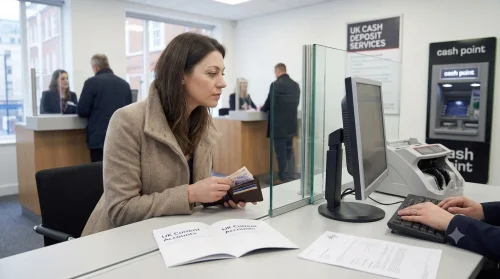
The maximum amount you can pay in as cash is not the same as the amount protected if an authorised institution fails.
From 1 December 2025, standard eligible deposit protection increased to £120,000 per eligible person, per authorised firm.
The official UK deposit protection rules also explain that accounts held under different brands may share one protection limit where they operate under the same banking licence.
The official statement says: “On 1 December 2025 the FSCS deposit protection rose to £120,000.”
How Does Protection Differ from Deposit Limits?
| Situation | Potential Protection |
| Eligible deposit with one authorised firm | Up to £120,000 per eligible person |
| Joint account with two eligible holders | Each eligible holder can receive protection up to their applicable limit |
| Qualifying temporary high balance | Up to £1.4 million for six months in most qualifying cases |
Temporary high-balance protection can apply after specified life events such as selling your main home or receiving an inheritance, subject to eligibility and evidence requirements.
The £120,000 figure is therefore a protection threshold, not a general maximum balance you are allowed to keep in a current account.
What Should You Check Before Depositing A Large Amount Into Your Current Account?
Before taking a substantial amount of physical cash to a branch or other paying-in point, check the rules that apply specifically to your account.
Large-Deposit Checklist
- Check whether your provider applies a transaction or daily cash limit.
- Look for an annual, calendar-year or rolling 12-month restriction.
- Compare branch, Post Office, ATM and cash-deposit-machine rules.
- Have reasonable evidence of the source of legitimate funds available where appropriate.
- Ask whether a bank transfer would be a suitable alternative to cash.
- Consider deposit protection if the payment will leave a particularly large balance.
You should also confirm whether coins are accepted, whether identification is required and how quickly the chosen deposit method will credit your account. These operational details can differ between providers and channels.
Checking before you travel can prevent you from arriving with more cash than the selected service is permitted to accept.
Conclusion
So, how much can you deposit in a current account in the UK? There is no single cash figure that applies to every account. Your practical limit depends on your provider, account type, deposit channel and any daily or annual restrictions in force.
The most important distinction is that a cash-paying-in limit, your total current-account balance and FSCS deposit protection are three separate things.
A bank may restrict how much physical cash you can deposit in one day without imposing the same restriction on an electronic credit or on the balance your account can hold.
Before making a large cash deposit, check the current rules for your own account and chosen paying-in method.
Frequently Asked Questions
Can A Bank Refuse To Accept A Large Cash Deposit?
A bank can apply its account terms, deposit limits and security procedures when deciding how a cash payment is handled. It may also ask questions or request supporting information before processing an unusual deposit.
Will Depositing A Large Amount Of Cash Affect My Current Account?
A legitimate large deposit does not automatically cause a problem, but unusual cash activity may lead to additional checks. Your provider may ask about the source of the money or request supporting paperwork.
Can I Pay Cash Into Someone Else’s Current Account In The UK?
It depends on the provider because third-party cash-deposit policies vary. Some providers instead require you to deposit the cash into your own account and transfer the money electronically.
Can I Make Several Smaller Cash Deposits Instead Of One Large Deposit?
Smaller transactions may still count towards daily, annual or rolling cash limits. You should use the normal permitted deposit route rather than trying to divide transactions to avoid legitimate checks.
How Long Does A Cash Deposit Take To Appear In A Current Account?
Timing depends on the provider and deposit method, and some card-based deposits can appear faster than deposits made with a paying-in slip. Check the terms of the channel you use before assuming the money will be available immediately.
Are Coin Deposits Included In Cash-Paying-In Limits?
Coins are cash, but providers can also impose separate rules on the quantity or way coins are accepted. Cash-deposit machines and branch counters may therefore have different practical requirements for notes and coins.
Does A Joint Current Account Allow You To Deposit More Cash?
Not automatically, because the provider determines how its cash allowance applies to joint accounts. One current policy gives each joint account a £20,000 annual cash limit shared between the account holders rather than £20,000 for each person.
Note: Cash-deposit limits are provider policies and can change. Before carrying a large amount of cash to a branch, Post Office or deposit machine, confirm the current limit for your specific account and deposit method.
