



Post Contents
Last checked: 4 July 2026. This guide is informational only and is not financial advice. Your home may be repossessed if you do not keep up repayments on a loan secured against it.
Quick Answer: What Is a Homeowner Loan?
A homeowner loan is borrowing secured against a property you own. It is often called a secured loan or second charge mortgage because it sits alongside your existing mortgage rather than replacing it.
The amount you can borrow usually depends on your income, credit history, existing mortgage balance, property value and available equity.
Homeowner loans may offer higher borrowing limits than unsecured loans, but they carry more serious risk. If you miss repayments, the lender may take action against the property.
Before applying, compare homeowner loans with unsecured loans, personal loans, remortgaging, a further advance from your mortgage lender and free debt advice if the borrowing is for debt consolidation.
What Is a Homeowner Loan in the UK?

A homeowner loan is a type of secured borrowing available to people who own a property. Instead of being based only on your credit profile, the loan is secured against your home. This gives the lender extra protection, but it also increases the risk for the borrower.
In the UK, homeowner loans are often described as secured loans, second charge mortgages or second mortgages.
A first charge mortgage is usually your main mortgage. A second charge loan is separate from that mortgage, but it is still secured against the same property.
If the property is sold or repossessed, the first mortgage is usually repaid before the second charge lender receives money.
A homeowner loan may be considered when a borrower wants to access a larger amount than they could get through an unsecured loan.
Common reasons include home improvements, consolidating debts, funding a major expense or covering large planned costs. However, the loan should only be taken if repayments are affordable both now and if household costs or interest rates change.
Before applying, it is sensible to compare the loan with alternatives such as a further advance from your mortgage lender, remortgaging, a low-interest personal loan or a balance transfer credit card if the borrowing is for existing card debt.
How Do Homeowner Loans Work?
A homeowner loan works by allowing you to borrow against the equity in your property. Equity is the difference between the value of your home and the amount still owed on your mortgage.
For example, if your home is worth £300,000 and your mortgage balance is £180,000, your equity is around £120,000.
The lender will usually assess:
- property value
- outstanding mortgage balance
- available equity
- income and employment status
- credit history
- existing debts
- monthly affordability
- purpose of the loan
- loan-to-value ratio
A homeowner loan is normally repaid monthly over a fixed term. Some loans may have fixed interest rates, while others may have variable rates.
A longer repayment term can reduce the monthly payment, but it may increase the total amount of interest paid over the full loan period.
When comparing options, look beyond the headline interest rate. APRC, fees, total repayable amount and early repayment charges can change the real cost of the loan.
Best Homeowner Loans in UK
The best homeowner loan in the UK depends on your property equity, credit profile, income, existing mortgage, loan purpose and repayment term.
There is no single provider that is best for every homeowner, so the safest approach is to compare several lenders and check the full cost before applying.
A homeowner loan is usually a secured loan or second charge mortgage. This means the loan is secured against your property and sits alongside your existing mortgage.
It can help some homeowners borrow larger amounts, but it also carries serious risk. Your home may be repossessed if you do not keep up repayments on a loan secured against it.
Before choosing a homeowner loan, compare the APRC, interest rate, arrangement fees, broker fees, valuation fees, early repayment charges, monthly repayment and total amount repayable.
For official guidance, the MoneyHelper guide to second charge mortgages explains how second mortgages work and why homeowners should consider the risks carefully: https://www.moneyhelper.org.uk/en/homes/buying-a-home/second-charge-or-second-mortgages
1. Loan.co.uk – Best for Comparing Secured Loan Options

Loan.co.uk secured loans
Loan.co.uk may be a useful option for homeowners who want to compare secured loan and homeowner loan products through a broker-style service.
The provider states that it offers secured loans from £15,000 to £1.5 million, with a free property valuation, no upfront fees or hidden charges, and poor credit plans available.
This may suit borrowers who want help comparing different secured loan products rather than approaching only one direct lender. It may also be suitable for people looking at debt consolidation or home improvement borrowing, depending on affordability and equity.
However, homeowners should check whether they are dealing with a lender or broker, whether any broker fee applies later in the process, and what APRC and total repayment figure is offered before signing. A lower monthly repayment may not mean the loan is cheaper overall if the repayment term is longer.
Best for: homeowners who want to compare secured loan options through a specialist broker-style provider.
Important checks: APRC, total repayable amount, broker status, fees, loan term, early repayment charges and whether the quote affects your credit score.
2. Pepper Money – Best for Complex Credit Profiles

Pepper Money second charge mortgages
Pepper Money is a specialist mortgage and second charge lender. It states that it offers second charge mortgage products for homeowners in England, Wales and Scotland, including borrowers who want to consolidate debt or fund home improvements.
Pepper Money may be relevant for homeowners with more complex circumstances, such as imperfect credit history, missed payments or non-standard income.
This does not mean approval is guaranteed. The lender will still need to assess affordability, income, credit history, property value and available equity.
Pepper Money also gives a clear warning that homeowners should think carefully before securing other debts against their home, because the home may be repossessed if repayments are not maintained.
Best for: homeowners with more complex credit circumstances who need a specialist second charge mortgage provider.
Important checks: affordability rules, rate type, product criteria, broker involvement, early repayment charges and whether debt consolidation is genuinely suitable.
3. United Trust Bank – Best for Specialist Second Charge Cases

| United Trust Bank second charge mortgages |
United Trust Bank offers second charge mortgages and says it can support a range of loan purposes, property types, construction types, complex income, self-employed applicants, contractors and borrowers with imperfect credit.
This may make United Trust Bank suitable for homeowners whose circumstances are not straightforward. For example, someone who is self-employed, has variable income or has been turned down by a mainstream lender may want to compare UTB against other specialist providers.
However, specialist lending still needs careful comparison. Borrowers should check whether the application must go through a broker, what fees apply, how affordability is assessed and whether the loan is fixed or variable.
Best for: homeowners with specialist income, self-employed income or non-standard borrowing circumstances.
Important checks: broker route, affordability assessment, property eligibility, loan purpose, fees, APRC and full repayment cost.
4. West One Loans – Best for Larger Second Charge Borrowing

West One second charge mortgages
West One Loans offers second charge mortgage products and states that loans up to £1 million may be available, subject to loan-to-value restrictions.
Its residential second charge criteria also mention terms up to 40 years and availability for employed, self-employed and retired applicants.
This may make West One a provider to compare for homeowners who need larger secured borrowing and have enough property equity. It may also be relevant where the borrower has more complex credit circumstances or needs a specialist second charge route.
Because larger loans can create larger long-term risk, homeowners should be especially careful with total repayment costs. A longer term can reduce the monthly repayment but may increase the total interest paid over time.
Best for: homeowners comparing larger second charge mortgage options.
Important checks: maximum loan-to-value, total repayable amount, term length, interest-only availability, broker process, fees and early repayment charges.
5. Selina Finance – Best for Flexible Homeowner Borrowing

Selina Finance homeowner loans
Selina Finance offers homeowner loans and secured lending products. It states that its homeowner loan can offer borrowing from £10,000 to £500,000 over terms from 5 to 30 years. Selina also offers a Home Equity Line of Credit, where borrowers may draw funds and pay interest only on the amount used.
This may suit homeowners who want flexibility rather than taking the full amount at once. It may also be useful for borrowers funding staged home improvements, where costs may be spread over time.
However, flexibility should not be confused with low risk. The borrowing is still secured against the property, so missed repayments could put the home at risk. Borrowers should compare both the homeowner loan and HELOC option carefully, including rates, fees and total cost.
Best for: homeowners who want flexible borrowing or staged access to funds.
Important checks: fixed loan vs HELOC, drawdown rules, fees, rate type, repayment structure, total cost and early repayment terms.
6. Shawbrook – Best for Existing or Specialist Property Finance Customers

| Shawbrook second charge mortgage help |
Shawbrook is a UK specialist bank offering savings, loans, business finance and property finance. Its help pages refer to second charge mortgages and explain that second charge mortgage repayments are usually capital and interest, meaning each monthly payment reduces the balance over the loan term.
For this article, Shawbrook should be positioned carefully. Instead of calling it one of the “best homeowner loan lenders” without checking live product availability, it is better to describe Shawbrook as a specialist finance provider that may be relevant for some property finance or existing second charge mortgage customers.
Before including Shawbrook in a lender list, check its latest product pages, whether it is accepting new second charge mortgage applications, and whether the route is direct or through brokers.
Best for: readers researching specialist property finance providers or existing Shawbrook second charge customers.
Important checks: current product availability, direct or broker access, eligibility, fees, customer type, repayment structure and whether the product is open to new applicants.
7. Central Trust – Best Replacement for Optimum Credit
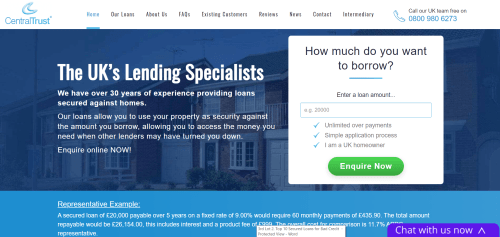
Central Trust second charge mortgages
Central Trust may be suitable for homeowners who want a more traditional second charge mortgage provider. It may also be relevant for borrowers who want to compare a specialist lender against broker-led options.
However, homeowners should still check the APRC, fees, repayment term, loan-to-value, early repayment charges and whether the loan is affordable over the full term.
Best for: homeowners comparing traditional second charge mortgage lenders.
Important checks: loan amount, APRC, total repayable amount, debt consolidation suitability, fees, eligibility and repayment term.
Best Homeowner Loans in UK: Simple Comparison
The table below gives a simple comparison of homeowner loan providers to help readers understand which option may suit different borrowing needs. This is not financial advice, and approval is not guaranteed. Always check the latest APRC, fees, repayment term and total repayable amount before applying.
| Provider | Best for | Why compare it? | Key thing to check |
| Loan.co.uk | Comparing secured loan options | Useful if you want to compare homeowner loan deals through a broker-style service. | Check broker fees, APRC and total repayment cost. |
| Pepper Money | Complex credit profiles | May suit homeowners with imperfect credit or non-standard circumstances. | Check eligibility, affordability and early repayment charges. |
| United Trust Bank | Specialist borrowing cases | May help borrowers with complex income, self-employment or specialist property needs. | Check whether you need a broker and what fees apply. |
| West One Loans | Larger secured borrowing | May suit homeowners looking for bigger second charge mortgage options. | Check loan-to-value limits, term length and total interest. |
| Selina Finance | Flexible borrowing | Offers homeowner loan options and may suit borrowers who want flexible access to funds. | Check rate type, fees and whether the loan is fixed or flexible. |
| Shawbrook | Specialist finance research | Useful to compare if you are researching specialist property finance options. | Confirm current homeowner loan availability before applying. |
| Central Trust | Direct second charge loans | A stronger replacement for outdated Optimum Credit, with active second charge mortgage information. | Check APRC, fees, loan term and debt consolidation suitability. |
A homeowner loan should not be chosen only because the monthly repayment looks low. Compare the full cost, including APRC, fees, total repayable amount and early repayment charges. Your home may be repossessed if you do not keep up repayments on a loan secured against it.
Which Homeowner Loan Provider Is Best Overall?
There is no single best homeowner loan provider for every borrower.
However, for this article, the strongest “best overall” positioning is:
Best overall for comparison: Loan.co.uk
Best for complex credit: Pepper Money
Best for specialist cases: United Trust Bank
Best for larger borrowing: West One Loans
Best for flexible borrowing: Selina Finance
Best replacement for outdated Optimum Credit: Central Trust
If you want the safest choice for SEO and YMYL, do not rank these providers as guaranteed “top 1 to top 7” lenders. Instead, present them as homeowner loan providers to compare, with clear “best for” labels and strong warnings around affordability, fees and repossession risk.
How to Choose the Best Homeowner Loan?
When comparing homeowner loans, do not focus only on monthly repayments. A lower monthly payment can look attractive, but it may mean a longer repayment term and a higher total cost over time.
Check these points before applying:
- whether the loan is secured against your home
- the APRC and total amount repayable
- fixed or variable interest rate
- broker, arrangement, valuation or legal fees
- early repayment charges
- monthly affordability now and in future
- whether the loan is for debt consolidation
- whether missed repayments could affect your mortgage or home
- whether you have checked alternatives such as unsecured loans, personal loans or remortgaging
If you are borrowing to consolidate debts, take extra care. Debt consolidation can reduce the number of monthly payments, but it may turn unsecured debts into debt secured against your home. The Citizens Advice guidance on mortgages and secured loans explains why secured borrowing should be considered carefully before using your property as security.
Alternatives to Homeowner Loans
A homeowner loan may not always be the best option. Depending on your circumstances, you may also want to compare:
- secured loans
- unsecured loans
- personal loans
- low-interest personal loans
- loans for bad credit
- balance transfer credit cards
- a further advance from your mortgage lender
- remortgaging
- free debt advice if repayments are already difficult
The best homeowner loan is not simply the one with the lowest advertised rate. It is the option that is affordable, transparent, suitable for your needs and clear about the risks of securing debt against your home.
What Are the Risks of Homeowner Loans?

Homeowner loans can be useful in the right circumstances, but they should not be treated as low-risk borrowing. The biggest risk is that the loan is secured against your property. If you do not keep up repayments, the lender may take legal action and your home could be repossessed.
Another risk is the total cost of borrowing. A homeowner loan may have a lower monthly repayment than an unsecured loan because the term is longer. However, paying over a longer period can mean you pay more interest overall.
Debt consolidation also needs care. Combining several debts into one homeowner loan may make payments easier to manage, but it can turn unsecured debts into secured debt.
This means credit cards, overdrafts or personal loans that were not previously secured against your home may become linked to your property.
You should also check whether the loan has:
- arrangement fees
- broker fees
- valuation fees
- legal fees
- early repayment charges
- variable interest rates
- missed payment charges
A homeowner loan may not be suitable if you are already struggling to pay your mortgage, council tax, rent, utilities or priority bills. In that situation, it may be better to speak to a free debt advice charity before borrowing more.
Homeowner Loan vs Unsecured Loan vs Remortgage
| Option | How it works | Main benefit | Main risk |
| Homeowner loan | A separate loan secured against your property | May allow larger borrowing | Your home is at risk if repayments are missed |
| Unsecured personal loan | Borrowing not secured against your home | No property security needed | May have lower limits or higher rates |
| Remortgage | Replacing your current mortgage with a new deal | May raise funds through your mortgage | Could lose a good existing mortgage rate |
| Further advance | Extra borrowing from your current mortgage lender | Keeps borrowing with existing lender | Still secured against your home |
| Balance transfer card | Moving credit card debt to a lower or 0% rate card | Can reduce short-term card interest | Rate may rise after the offer period |
The best option depends on your credit profile, mortgage deal, property equity, loan purpose and affordability. A homeowner loan should be compared against these alternatives before you apply
Conclusion
Homeowner loans can help UK property owners access larger borrowing, but they carry serious responsibility because the loan is secured against the home.
Before applying, compare APRC, fees, repayment term, total repayable amount and alternatives such as personal loans, remortgaging or a further advance.
If the borrowing is for debt consolidation or you are already struggling with repayments, seek free debt advice before turning unsecured debts into secured borrowing.
FAQs About Homeowner Loans
Are homeowner loans the same as secured loans?
Yes, homeowner loans are usually a form of secured loan. The borrowing is secured against your property, which means the lender has security if repayments are not made. This can allow larger borrowing, but it also means your home may be at risk.
Can I get a homeowner loan with bad credit?
Some lenders may consider homeowner loans for borrowers with bad credit, but approval is not guaranteed. The lender will usually check your income, affordability, credit history, property value and available equity before making a decision.
Is a homeowner loan better than an unsecured loan?
A homeowner loan may allow a larger loan amount or longer repayment term, but it is riskier because it is secured against your property. An unsecured loan does not use your home as security, although missed payments can still damage your credit score and lead to debt action.
Can I use a homeowner loan for debt consolidation?
Yes, some people use homeowner loans to consolidate debts. However, this needs careful thought because unsecured debts may become secured against your property. A lower monthly payment may also cost more overall if the repayment term is longer.
What happens if I miss homeowner loan repayments?
If you miss repayments, the lender may charge fees, report missed payments to credit reference agencies and take further action. Because the loan is secured against your property, serious arrears could put your home at risk.
Should I remortgage instead of taking a homeowner loan?
Remortgaging may be an option, but it depends on your current mortgage rate, early repayment charges, affordability and how much extra you need to borrow. A homeowner loan may avoid replacing your main mortgage, but it still adds secured debt against your property.
What should I compare before applying?
Compare APRC, monthly repayment, total repayable amount, fees, repayment term, early repayment charges, lender status and whether the loan is fixed or variable. You should also compare alternatives before applying.
How We Checked This List?
For this guide, we reviewed publicly available provider information, loan type, stated borrowing ranges, repayment terms, customer eligibility information and whether the provider appears relevant to homeowner or secured borrowing.
We also checked official guidance from the FCA, MoneyHelper and Citizens Advice to make sure the article explains the main risks of secured borrowing.
Source Links
https://www.loan.co.uk/secured-loans/
https://www.utbank.co.uk/second-charge-mortgages/
https://www.westoneloans.co.uk/second-charge-mortgages/
https://www.selinafinance.co.uk/products/homeowner-loan
https://www.shawbrook.co.uk/property-finance/help/second-charge-mortgages/
